Cravings vs Food Noise: What's the Difference?
They feel similar. They aren't the same signal.
Written by BeyondGLP Editorial Team · Medically reviewed by Dr. Gabriel, MD
Key Takeaways
- Cravings and food noise both show up as “thinking about food,” but they come from different systems — cravings are driven mainly by reward and dopamine circuitry, food noise by gut-brain satiety signaling.
- Cravings tend to be specific (a particular food, a particular texture) and reward-driven; food noise tends to be general and persistent, showing up regardless of what's available.
- Foods engineered to combine fat, sugar, and salt in specific ratios are built to trigger the reward response that drives cravings — this is now a formally studied, quantifiable property of food, not a vague description.
- Telling the two apart matters, because the more effective response to each is different.

From Dr. Gabriel
Patients often use “craving” and “food noise” interchangeably, and I understand why — from the inside, they can feel like the same static. But when I ask more specific questions — is it a particular food you want, or just a general sense you should be eating — the two usually separate cleanly. That distinction changes what I'd actually recommend.
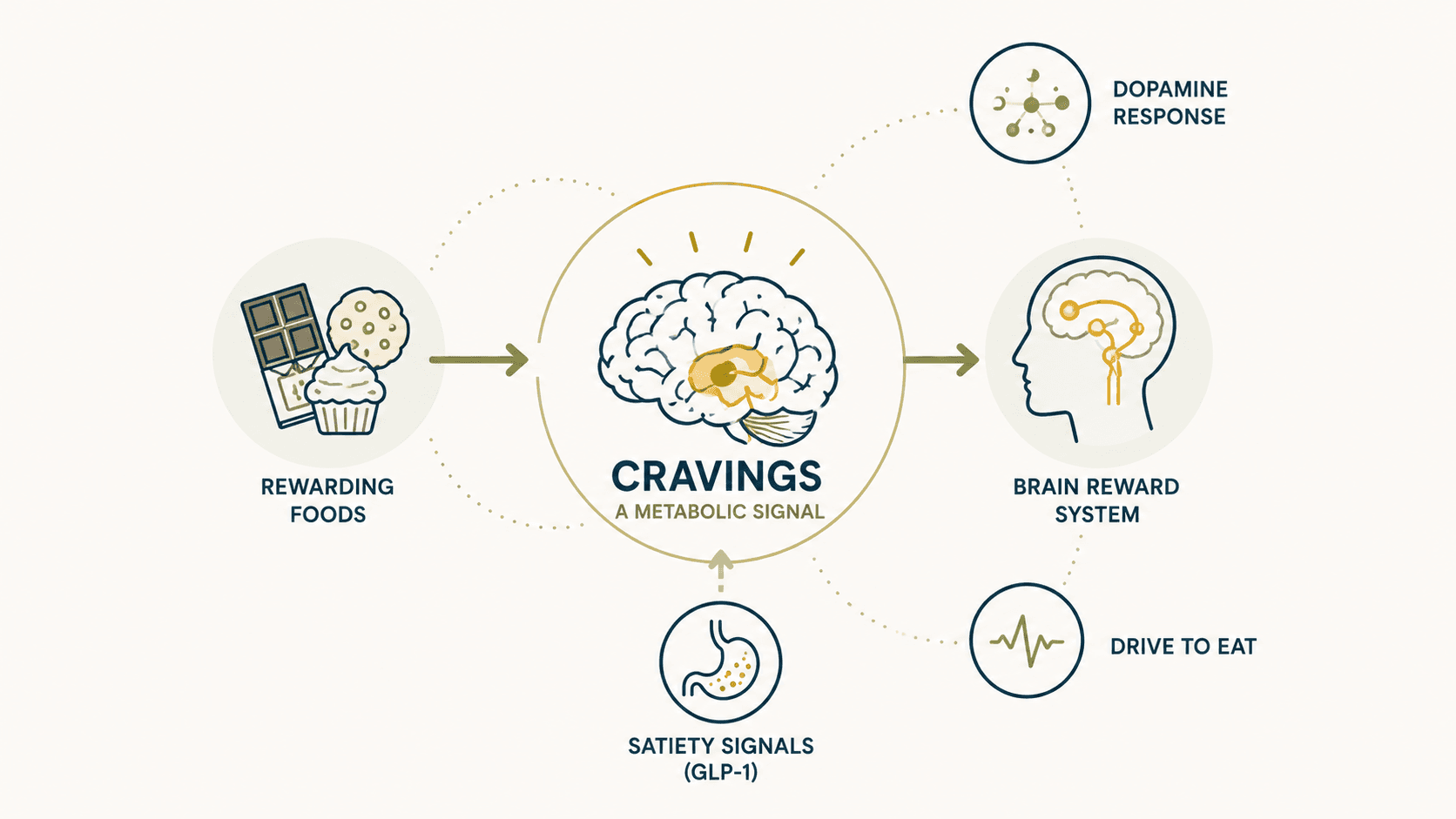
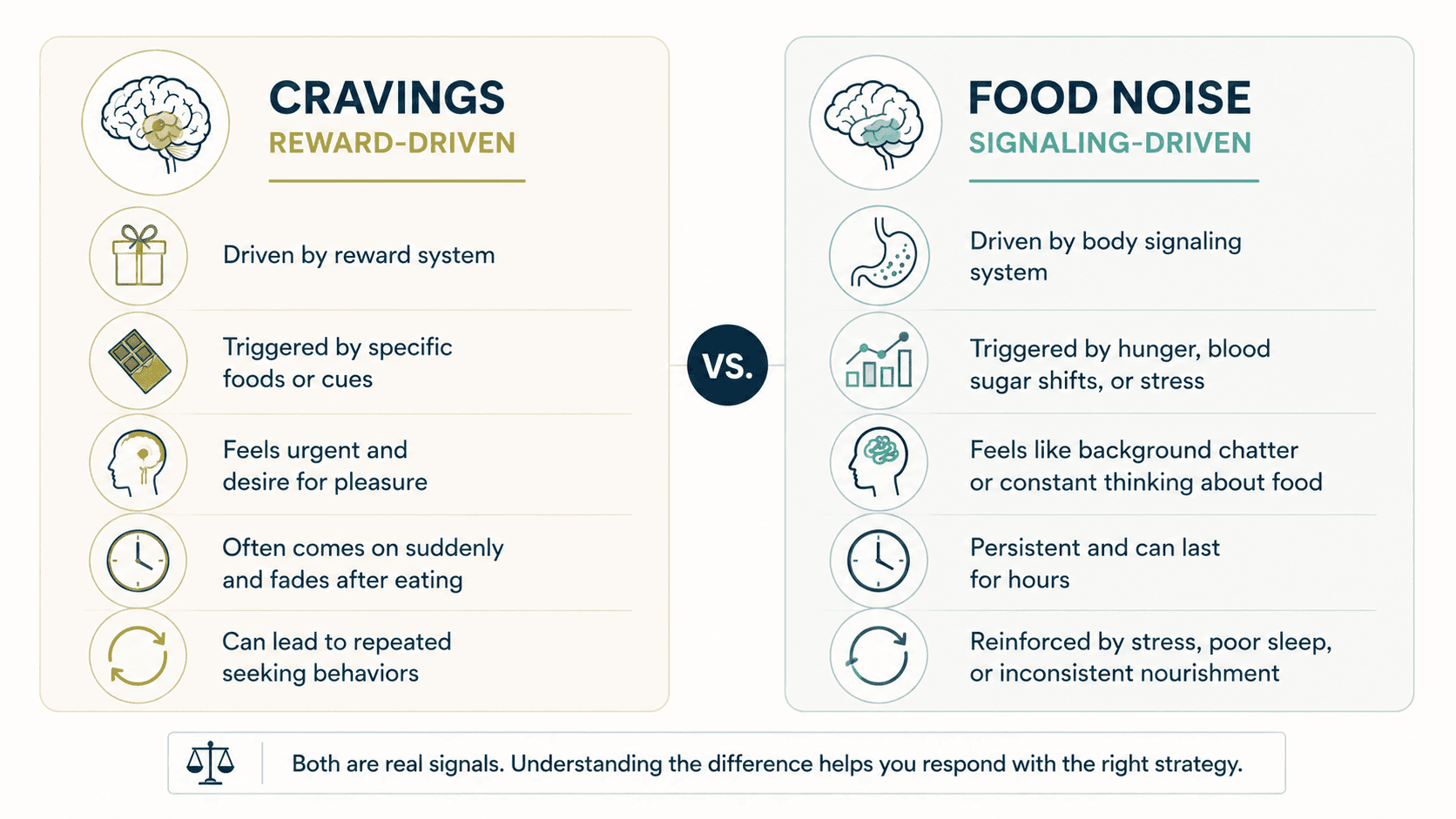
You want something specific — chocolate, chips, something salty — and it's hard to think about anything else until you have it. That's a craving. Compare that to a vaguer, more constant sense that you should be eating, unattached to any particular food, that just won't quiet down. That's food noise. Both can feel consuming, and both get lumped together in everyday conversation, but they're generated by different systems in your body, and understanding which one you're dealing with changes what actually helps.
What this means in plain English
A craving is your brain's reward system asking for a specific experience — usually one built around fat, sugar, or salt in combinations your brain finds especially rewarding. Food noise is your appetite-regulation system failing to deliver a clear “you're satisfied” signal, so your brain keeps returning to the general subject of eating. One is about wanting something in particular. The other is about not getting a clear “you're done” message at all.
Why this happens biologically
Cravings are largely a reward-circuit phenomenon. Foods that combine fat, sugar, and sodium in specific ratios have been formally defined and quantified as “hyperpalatable” — not a vague marketing term, but a measurable category based on precise thresholds of these ingredients. Applying that definition to the US food supply, researchers found that 62% of foods available in the United States meet the hyperpalatable threshold (Fazzino et al., Obesity, 2019). These combinations are, by design or by accident of food science, unusually effective at triggering the brain's reward response.
The neuroscience behind this response has been documented since the foundational work of Avena and colleagues, who demonstrated in animal models that intermittent access to sugar produces the same four hallmarks associated with substance dependence — bingeing, withdrawal, craving, and increased sensitivity over time (Avena et al., Neuroscience & Biobehavioral Reviews, 2008). More recently, researchers have proposed formal criteria for evaluating whether highly processed foods meet the scientific bar for being considered addictive substances, using the same framework applied to drugs of abuse (Gearhardt & DiFeliceantonio, Addiction, 2023). This doesn't mean any single food is “addictive” for everyone — the debate in the field is genuinely ongoing — but it does mean cravings for specific hyperpalatable foods have a documented neurological basis, rather than reflecting a personal failing.
Food noise runs through a different circuit entirely — the gut-brain satiety pathway. When you eat, your gut releases GLP-1, which signals through the vagus nerve and bloodstream to your brainstem and hypothalamus that you've eaten and can stop (Drucker, Cell Metabolism, 2018; Brierley & de Lartigue, British Journal of Pharmacology, 2022). When that signal is weak, delayed, or contradicted by a blood sugar dip a couple of hours later (Wyatt et al., Nature Metabolism, 2021), your brain doesn't get a clean “you're done” message, and general thoughts about food persist even without a specific craving attached to them.
A randomized controlled feeding study helps illustrate the reward side specifically: when researchers gave the same participants a diet built around ultra-processed foods and one built around whole foods, matched for calories and macronutrients, people on the ultra-processed diet ate faster and consumed meaningfully more calories per day — a pattern consistent with the reward system driving intake past the point of actual need (Hamano et al., Diabetes, Obesity and Metabolism, 2024).
How it connects to the Metabolic Signaling System
Cravings and food noise often coexist, which is part of why they get confused. A diet high in hyperpalatable, engineered foods can simultaneously activate reward circuitry (driving specific cravings) and blunt the gut-brain satiety response (driving general food noise), because the same foods that are hardest to stop eating are often also the ones that are eaten fastest and processed with the weakest natural satiety signal. Untangling which one you're experiencing in a given moment is genuinely useful, because it points to a different lever. If a GLP-1 medication is part of your picture, it acts on the satiety side of this specifically — GLP-1 support and aftercare covers what that changes.
What standard advice often misses
Generic advice to “resist cravings” or “practice portion control” treats both experiences as the same willpower test. But a specific craving for something salty and sweet is a different problem than a general, food-noise-style sense that you should be eating. Addressing a craving might mean looking at what's actually in your usual food choices. Addressing food noise more often means looking at blood sugar stability and overall gut-brain signaling. Applying the wrong fix to the wrong problem is a common reason people feel like nothing works.
How to know where you stand
If you can name the specific food you want, you're likely dealing primarily with a craving. If the sense that you should eat is vague, persistent, and not attached to anything in particular, that's more consistent with food noise. Most people experience some blend of both, in proportions that vary — which is exactly the kind of thing worth mapping for yourself rather than guessing at.
Common Questions
Can I have cravings and food noise at the same time?
Yes, and many people do. A diet heavy in hyperpalatable foods can drive both a specific reward-based craving and a more general satiety-signaling problem simultaneously, since the two systems interact rather than operating in isolation.
Are cravings a sign of “food addiction”?
There's active scientific debate about whether certain highly processed foods meet the formal criteria for addictive substances, and researchers have proposed specific scientific criteria to evaluate this question. What's well established is that cravings for hyperpalatable foods have a real, documented neurological basis — not that any individual person is “addicted” in a diagnostic sense.
Does one matter more than the other for long-term health?
Neither is inherently worse — they're just different signals worth understanding separately, since the useful next step differs depending on which one is showing up for you.
Related metabolic signals
Scientific References
- Fazzino TL, Rohde K, Sullivan DK. Hyper-Palatable Foods: Development of a Quantitative Definition and Application to the US Food System Database. Obesity, 2019.
- Avena NM, Rada P, Hoebel BG. Evidence for sugar addiction: Behavioral and neurochemical effects of intermittent, excessive sugar intake. Neuroscience & Biobehavioral Reviews, 2008.
- Gearhardt AN, DiFeliceantonio AG. Highly processed foods can be considered addictive substances based on established scientific criteria. Addiction, 2023.
- Drucker DJ. Mechanisms of Action and Therapeutic Application of Glucagon-like Peptide-1. Cell Metabolism, 2018.
- Brierley DI, de Lartigue G. Reappraising the role of the vagus nerve in GLP-1-mediated regulation of eating. British Journal of Pharmacology, 2022.
- Wyatt P, Berry SE, Finlayson G, et al. Postprandial glycaemic dips predict appetite and energy intake in healthy individuals. Nature Metabolism, 2021.
- Hamano S, Sawada M, Aihara M, et al. Ultra-processed foods cause weight gain and increased energy intake associated with reduced chewing frequency: A randomized, open-label, crossover study. Diabetes, Obesity and Metabolism, 2024.
Understanding which pattern you're dealing with is the first step toward addressing it directly.
Take the free BeyondGLP Metabolic Assessment →Educational content only. Information explains physiology and is not intended as medical advice. Always consult a qualified healthcare provider regarding medical decisions.