Metabolic Lab Testing: Which Tests, and What They Miss
The core panel worth asking for — and the one marker most annual physicals skip.
Written by Dr. Steven Gabriel, MD · Board-Certified Emergency Physician · Founder, BeyondGLP · September 2026
Key Takeaways
- A standard annual physical often measures fasting glucose but skips fasting insulin — the marker that tends to shift earliest.
- Insulin resistance can build for years while standard labs still look “normal.”
- The American Heart Association's metabolic syndrome criteria give five specific, checkable numbers — not a vague concept.
- Only about 1 in 8 US adults meets every criterion for optimal metabolic health, including many people at a “normal” weight.
- Reading your own results without a clinician risks over- or under-reacting to numbers that need context.

From Dr. Gabriel
“The test I ask for that most people have never had checked is fasting insulin. Glucose can look completely normal for years while insulin quietly climbs to compensate — and by the time glucose finally moves, that compensation has often been happening for a while already. It’s one extra tube of blood, and it’s often the most informative one on the whole panel.”
The core panel worth asking for is fasting glucose, fasting insulin, HbA1c, a standard lipid panel with the triglyceride-to-HDL ratio calculated, and hs-CRP — plus your waist circumference. Most annual physicals check some of these but routinely skip fasting insulin, which is often the earliest marker to move.
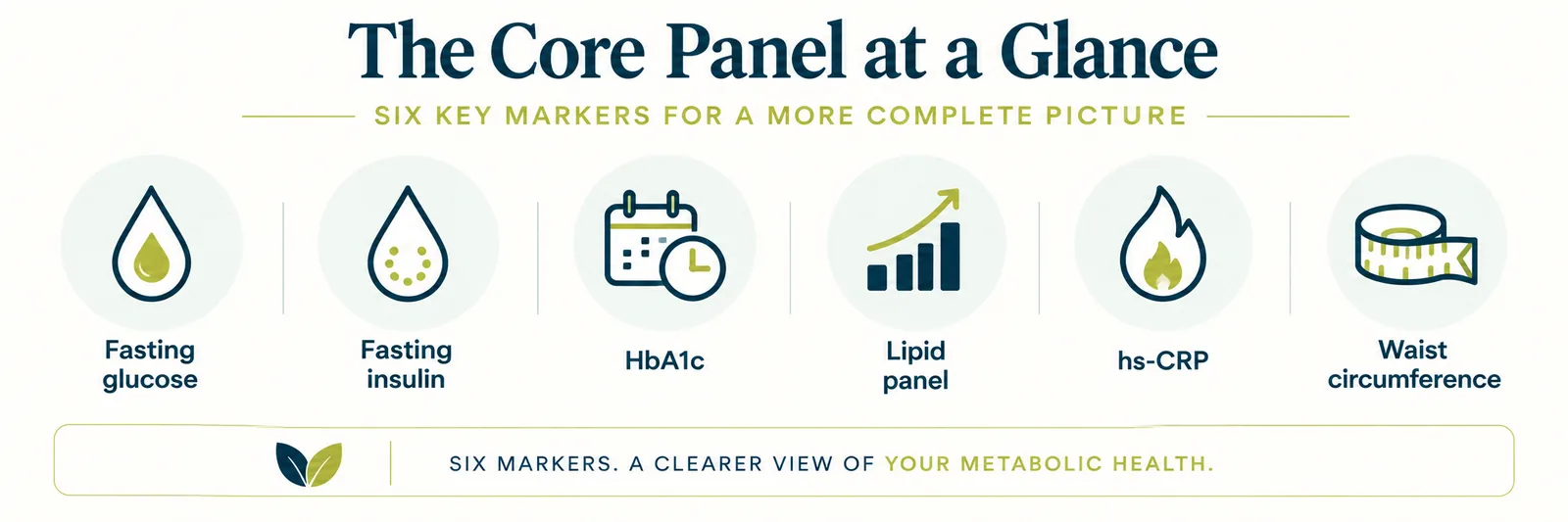
The Table: What to Ask For, What It Measures, Why It Matters
| Test | What it measures | Why it matters |
|---|---|---|
| Fasting glucose | Blood sugar after ~8 hours without food | Baseline marker; one of the American Heart Association's five metabolic syndrome criteria [1] |
| Fasting insulin | Insulin level in the same fasting blood draw | Often the earliest marker to shift; predicts cardiovascular risk independent of glucose [2] |
| HbA1c | Average blood sugar over roughly 3 months | A wider window than a single fasting reading — smooths out day-to-day swings |
| Lipid panel (triglycerides, HDL, LDL) | Fat particles circulating in blood | Triglyceride and HDL levels are both part of the metabolic syndrome criteria [1] |
| hs-CRP | Low-grade systemic inflammation | Inflammation is one of the recognised mechanisms behind insulin resistance [3] |
| Waist circumference (measurement, not a lab) | Abdominal fat specifically | More predictive of metabolic risk than BMI alone for many people [4] |
What a Standard Panel Doesn’t Include, and Worth Asking For Separately
Fasting insulin is the clearest gap: it’s not part of most standard annual panels, even though a meta-analysis of prospective cohort studies found elevated fasting insulin independently predicted coronary heart disease risk — ahead of when fasting glucose typically moves out of range [2]. Some clinicians also calculate HOMA-IR, a derived number from fasting glucose and insulin together, as an additional way of estimating insulin resistance; ask your physician whether that’s useful in your specific case, since reference ranges and clinical interpretation vary.
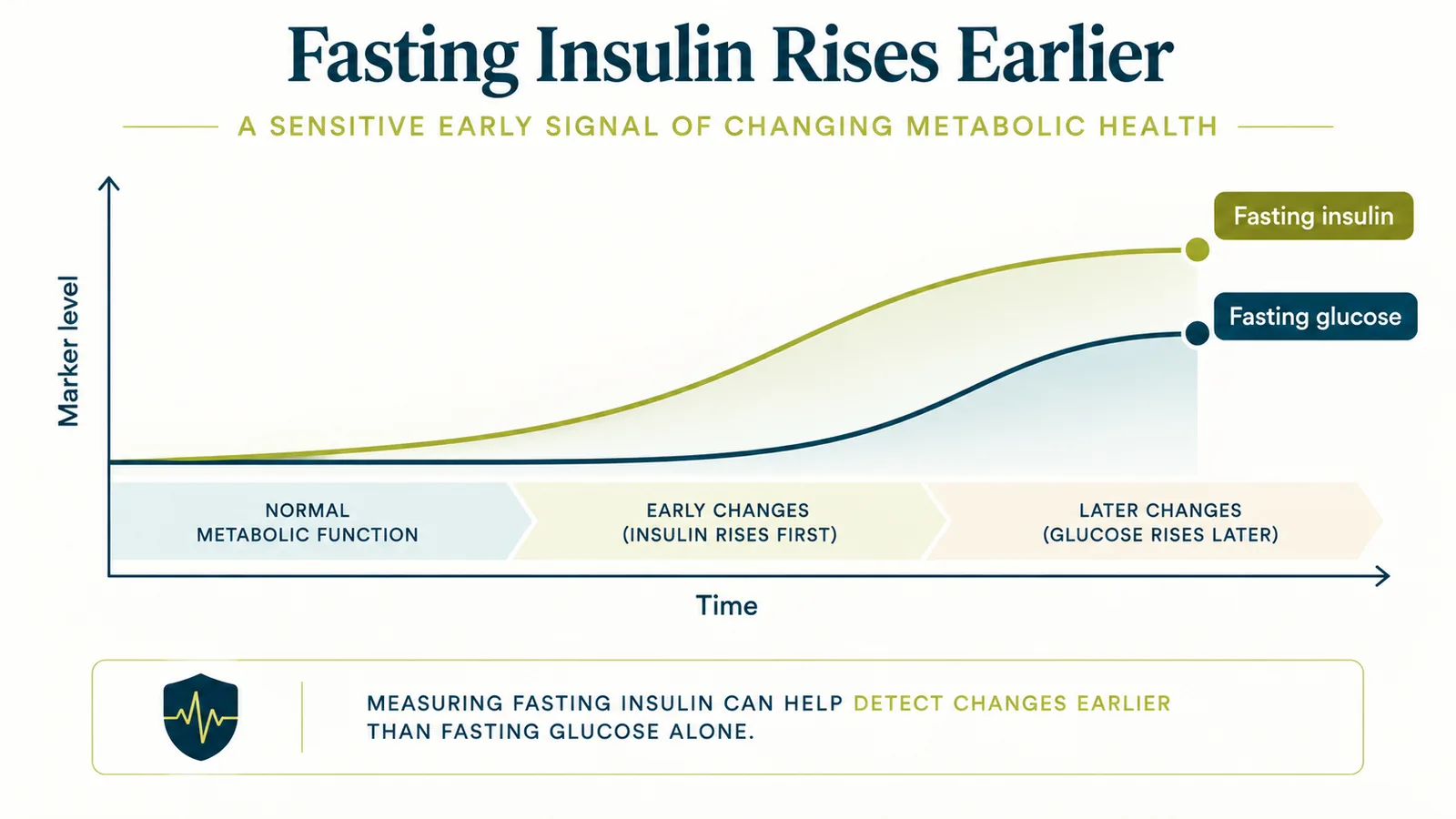
How to Read Results Without Self-Diagnosing
Reference ranges vary by lab, and a single value outside a “normal” range isn’t a diagnosis on its own — trends over repeated tests generally matter more than any one snapshot. Insulin resistance in particular can develop gradually, through mechanisms including fat accumulation in liver and muscle tissue, low-grade inflammation, and mitochondrial changes, well before standard labs move outside their reference range [3]. The National Institute of Diabetes and Digestive and Kidney Diseases has detailed public information on insulin resistance and prediabetes if you want a deeper, authoritative starting point [5]. This page is meant to help you ask better questions of your clinician — not to replace the conversation with one.
Free · Physician-reviewed · Two pages, printable
When to Bring This to a Clinician
If several markers come back borderline or abnormal together, if there’s a family history of type 2 diabetes or cardiovascular disease, or if you’re noticing symptoms like persistent fatigue or unusual thirst, that combination is worth a direct conversation with your physician about what your specific numbers mean and whether further testing makes sense.
Common Questions
What blood tests show metabolic health?
Fasting glucose, fasting insulin, HbA1c, a lipid panel, and hs-CRP together give a reasonably complete picture, alongside a simple waist circumference measurement.
Is fasting insulin part of a standard panel?
Usually not — it's a common gap in routine annual bloodwork, even though it's one of the earliest markers to shift and independently predicts cardiovascular risk.
What is a metabolic screening?
A metabolic screening typically refers to a panel of blood tests and measurements — like those in the table above — used to check for early signs of insulin resistance, dyslipidemia, or metabolic syndrome, generally before symptoms appear.
Can I ask my doctor for these tests?
Yes — you can specifically request fasting insulin, HbA1c, and hs-CRP alongside a standard lipid and glucose panel at your next visit. Most physicians are receptive to a specific, informed request like this.
Scientific References
- 1.Grundy SM, Cleeman JI, Daniels SR, et al. Diagnosis and Management of the Metabolic Syndrome: An American Heart Association/National Heart, Lung, and Blood Institute Scientific Statement. Circulation, 2005. PMID: 16157765.
- 2.Xun P, et al. Fasting insulin concentrations and incidence of hypertension, stroke, and coronary heart disease: a meta-analysis of prospective cohort studies. Am J Clin Nutr, 2013. PMID: 24132974.
- 3.Mechanisms of insulin action and insulin resistance. Physiol Rev, 2018. PMID: 30067154.
- 4.Neeland IJ, Ross R, Després JP, et al. Visceral and ectopic fat, atherosclerosis, and cardiometabolic disease: a position statement. Lancet Diabetes Endocrinol, 2019. PMID: 31292139.
- 5.National Institute of Diabetes and Digestive and Kidney Diseases (NIDDK). Insulin Resistance and Prediabetes (institutional source, accessed June 2026).
- 6.Prevalence of optimal metabolic health in American adults: NHANES 2009–2016. Metab Syndr Relat Disord, 2019. PMID: 30484738.
Educational only; not medical advice. This page describes common metabolic lab tests and their general clinical relevance; it does not diagnose any condition and does not replace interpretation by a qualified clinician. Reviewed by Dr. Steven Gabriel, MD, September 2026.
Physician-built · Free · 2 min