What Is Metabolic Health? A Plain-English Definition
Most people track their weight. What they should be tracking is this.
Written by Dr. Steven Gabriel, MD · Board-Certified Emergency Physician · June 2026
Key Takeaways
- Metabolic health describes how well your body produces, uses, and stores energy, and it is not the same as your weight or BMI.
- Only 12.2% of US adults meet all criteria for optimal metabolic health, including many people with normal weight and normal lab values.
- The five clinical markers, blood sugar, blood pressure, waist circumference, triglycerides, and HDL, tell a more complete story than weight alone.

From Dr. Gabriel
“Two people can walk into a clinic at the same weight, with similar lab results, and have completely different metabolic pictures. One has stable blood sugar, good insulin sensitivity, and healthy fat distribution. The other has elevated fasting insulin, accumulating visceral fat, and elevated blood pressure — none of which shows up as a red flag on a standard panel. What metabolic health actually measures is the efficiency of your internal systems across five domains: appetite, energy, digestion, sleep and recovery, and stress hormones.”
You’ve perhaps had a doctor tell you your bloodwork looks fine: normal weight, normal glucose, nothing obviously wrong. And yet something feels off. The energy crashes, the cravings, the sense that your body isn’t responding the way it used to. That gap between “normal” and actually feeling well lives in your metabolic health. Metabolic health describes how efficiently your body produces, uses, and stores energy across five signal domains: Appetite & Hunger Signals, Energy & Blood Sugar Control, Digestion & Gut Health, Sleep & Recovery, and Hormones & Stress Response. It is not a weight category and not a diagnosis — it is a measure of how well your internal biology is functioning. This guide explains what it means, what the markers are, and how to start understanding where you stand.
What does metabolic health actually mean?
Metabolic health is a measure of how well your body’s energy systems are functioning, not how your body looks from the outside.
The word “metabolic” refers to metabolism: the entire set of chemical processes your body uses to convert food into energy, regulate blood sugar, store and mobilise fat, build and repair tissue, and keep organs functioning. When these processes work efficiently and in balance, you are metabolically healthy. When one or more systems fall out of range, even subtly, the downstream effects ripple across energy, mood, hunger, body composition, and long-term disease risk.
According to the National Institute of Diabetes and Digestive and Kidney Diseases, metabolic health is closely connected to how the body handles insulin, the hormone responsible for moving glucose from the bloodstream into cells. When insulin works efficiently, blood sugar stays stable, appetite signals are reliable, and energy is consistent. When insulin sensitivity declines, the whole system begins to compensate in ways that are rarely felt immediately but accumulate over years.
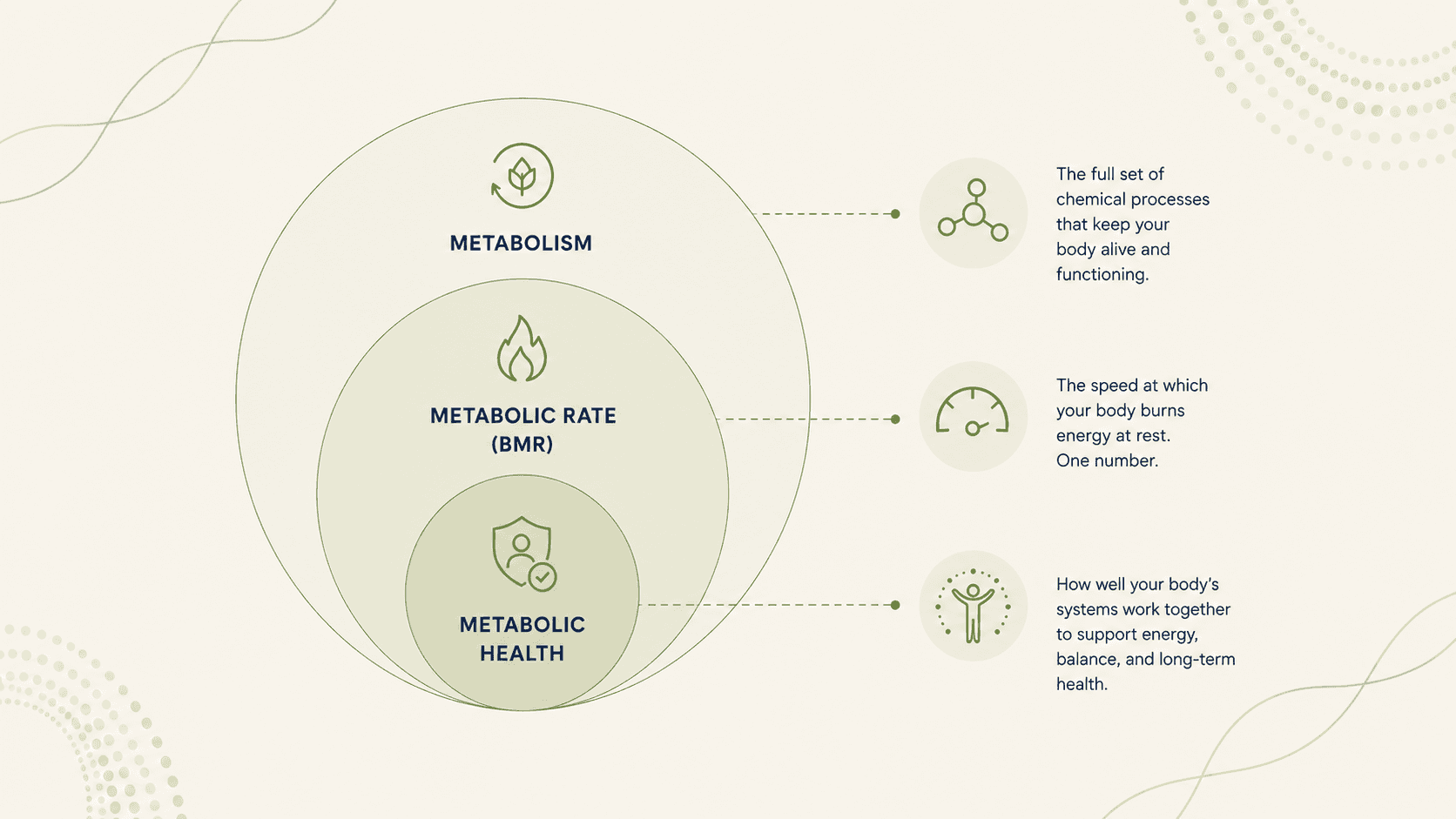
Three terms worth separating
Metabolism
The broad set of chemical processes, everything from converting carbohydrates to glucose to building proteins. Everyone has a metabolism; the question is how efficiently it runs.
Metabolic rate (BMR)
The speed at which your body burns energy at rest. It is one number within the larger picture of metabolic function, not a measure of health on its own.
Metabolic health
The overall state of all these systems together: the composite picture that determines whether your body is handling energy, blood sugar, fat storage, and appetite signals the way it should be.
What are the markers clinicians look at?
Five commonly used clinical indicators give a meaningful picture of metabolic health, and most people have never had all five evaluated together.
The American Heart Association uses five markers to assess metabolic health: fasting blood glucose, blood pressure, waist circumference, fasting triglycerides, and HDL cholesterol. Each alone tells a partial story. Together, they describe how well the body’s energy and cardiovascular systems are functioning.
What standard panels often miss is fasting insulin, which can become elevated years before blood glucose moves out of the normal range. A meta-analysis of 22 prospective cohort studies found that adults with the highest fasting insulin levels had a 63% higher risk of hypertension and a 50% higher risk of coronary heart disease than those with the lowest levels (Xun P, Wu Y, He Q, He K, American Journal of Clinical Nutrition, 2013, PMID 24132974). Standard panels measure glucose; insulin is rarely checked.
Waist circumference matters more than weight for the same reason. Visceral fat, stored around the abdominal organs rather than under the skin, is metabolically active in ways subcutaneous fat is not. A position statement in The Lancet Diabetes & Endocrinology(2019) found that visceral fat predicted cardiovascular events independent of BMI, meaning people at a “normal” weight with elevated visceral fat still carried significantly elevated risk (Neeland et al., The Lancet Diabetes & Endocrinology, 2019, PMID 31301983).
Elevated triglycerides (at or above 150 mg/dL) alongside low HDL (below 40 mg/dL for men, below 50 mg/dL for women) is one of the most consistent markers of underlying insulin resistance, often appearing well before any formal diagnosis. Most people have never been told to look at the triglyceride-to-HDL ratio. It is one of the most informative numbers in standard bloodwork.
Can you be metabolically healthy at any weight?
Yes, and this is one of the most important and least understood facts about metabolic health.
Research consistently shows that body weight and metabolic health are related but distinct. A cross-sectional analysis of 8,721 US adults using NHANES data, published in Metabolic Syndrome and Related Disorders(2019), found that only 12.2% of US adults met all five criteria for optimal metabolic health, and critically, poor metabolic health appeared across all BMI categories, including individuals classified as normal weight (Araújo et al., PMID 30484738). The Centers for Disease Control and Prevention similarly recognises that metabolic risk factors are not confined to individuals who are classified as overweight or obese.
Some individuals carry weight above standard BMI thresholds and maintain healthy blood sugar, blood pressure, and lipid markers. Others at a “normal” BMI have elevated insulin, accumulating visceral fat, and declining HDL, none visible externally, none triggering concern on a standard physical. According to the World Health Organization, BMI alone is an insufficient measure because it does not capture fat distribution, insulin function, or the other markers that actually determine metabolic risk. Weight is one signal. It is not the whole picture.
Why metabolic health matters beyond the scale
Poor metabolic health rarely announces itself with dramatic symptoms. It builds slowly, across years, through small signals that are easy to explain away.
Afternoon energy crashes that seem like they’re from not sleeping well. Cravings that don’t match what you’ve eaten. Weight that shifts in ways that don’t respond predictably to diet changes. Blood pressure at the high end of normal for years. These are the early expressions of metabolic systems that are working harder than they should be, not a disease, but a trajectory.
The significance extends beyond how you feel today. Metabolic dysfunction, particularly insulin resistance, is the common upstream factor in type 2 diabetes, cardiovascular disease, and accelerated biological ageing. Addressing it at the early signal stage, before it reaches diagnostic thresholds, is where the greatest leverage exists.
Free · Physician-reviewed · Results in under 5 minutes
How to know where you stand
A standard annual physical typically assesses fasting glucose and basic lipids. What it rarely captures is the full metabolic picture: fasting insulin, visceral fat distribution, the relationship between triglycerides and HDL, or how well blood sugar is being handled in the hours after meals.
The BeyondGLP Metabolic Assessment evaluates all five signal domains — Appetite & Hunger Signals, Energy & Blood Sugar Control, Digestion & Gut Health, Sleep & Recovery, and Hormones & Stress Response — to build a personalised metabolic profile. It is not a diagnostic tool and does not replace clinical evaluation. It is a starting point: a way to understand which signals in your metabolic system may need attention, before those signals become diagnoses.
Common Questions
What does metabolically healthy mean?
Metabolically healthy means your body's key energy and cardiovascular systems, blood sugar, blood pressure, waist circumference, triglycerides, and HDL cholesterol, are functioning within healthy ranges. According to the National Institute of Diabetes and Digestive and Kidney Diseases, insulin sensitivity is central to this: when the body uses insulin efficiently, blood sugar stays stable and the signals governing appetite, energy, and fat storage work as they should.
Can you be overweight and metabolically healthy?
Yes. A 2019 analysis of 8,721 US adults found poor metabolic health present across all BMI categories, including individuals at normal weight (Araújo et al., Metabolic Syndrome and Related Disorders, 2019, PMID 30484738). Some people carry extra weight and maintain healthy markers across all five indicators. Others at a 'normal' BMI have elevated insulin, accumulating visceral fat, and declining HDL. Weight is one signal; it is not a reliable proxy for metabolic health.
How do I check my metabolic health?
A full assessment looks at fasting blood glucose, fasting insulin, blood pressure, waist circumference, fasting triglycerides, and HDL cholesterol. Standard physicals often include glucose and basic lipids but omit fasting insulin and waist circumference, the two markers most sensitive to early dysfunction. The BeyondGLP Metabolic Assessment evaluates all five signal domains — Appetite & Hunger Signals, Energy & Blood Sugar Control, Digestion & Gut Health, Sleep & Recovery, and Hormones & Stress Response — through a structured self-reported profile. It does not replace clinical evaluation or laboratory testing.
Scientific References
- 1.Araújo J, Cai J, Stevens J. Prevalence of optimal metabolic health in American adults: National Health and Nutrition Examination Survey 2009–2016. Metabolic Syndrome and Related Disorders, 2019. PMID 30484738.
- 2.Xun P, Wu Y, He Q, He K. Fasting insulin concentrations and incidence of hypertension, stroke, and coronary heart disease: a meta-analysis of prospective cohort studies. American Journal of Clinical Nutrition, 2013. PMID 24132974.
- 3.Neeland IJ, Ross R, Després JP, et al. Visceral and ectopic fat, atherosclerosis, and cardiometabolic disease: a position statement. The Lancet Diabetes & Endocrinology, 2019. PMID 31301983.
- 4.National Institute of Diabetes and Digestive and Kidney Diseases (NIDDK). Insulin Resistance and Prediabetes.
- 5.American Heart Association. About Metabolic Syndrome.
- 6.Centers for Disease Control and Prevention. Adult Obesity Facts.
- 7.World Health Organization. Obesity and Overweight: Key Facts.
See which of your five signal domains may need attention
Educational content only. Information explains physiology and is not intended as medical advice. Always consult a qualified healthcare provider regarding medical decisions.