Medication or Natural GLP-1 Support? A Doctor-Led Framework to Decide
An honest, doctor-led framework — not a sales pitch for either path.
Written by BeyondGLP Editorial Team · Medically reviewed by Dr. Gabriel, MD
Key Takeaways
- This isn’t medication versus natural support as rivals — it’s a decision that depends on your Metabolic Score, your goals, and your medical context, and there’s a real framework for making it.
- GLP-1 medications amplify a signal your body already produces; natural support (protein, fiber, post-meal movement) works on the same signal, just with a smaller, slower effect.
- A meaningful share of weight lost on GLP-1 medication can be lean mass — a reason to plan for muscle protection regardless of which path you choose. [5]
- Many people don’t choose one path exclusively — combining medication with natural-support habits is common and often the more sustainable approach.

From Dr. Gabriel
Patients often walk in assuming this is a loyalty test — pick “the medication” or pick “the natural route” and defend it. It isn’t. I’ve prescribed GLP-1 medications to patients whose metabolic score and medical history clearly called for it, and I’ve told other patients, just as confidently, that protein, fiber, and a walk after dinner would get them most of the way there. The decision isn’t about which camp you’re in. It’s about what your own metabolic picture actually needs.
If you’ve been reading about GLP-1 medications and also seeing “natural alternatives” marketed everywhere, you’ve probably landed on the same question a lot of people bring to us: do I actually need the medication, or can I get real results without it? There isn’t a universal answer, and anyone who gives you one without knowing your metabolic picture is guessing. What there is, is a framework — the same one we’d use with a patient in clinic — built around your Metabolic Score, your goals, and your medical context. This page walks through that framework so you can see where you’d likely land, and then the free BeyondGLP Metabolic Assessment can tell you with your own numbers, not averages.
How Each Path Actually Works
Both paths work on the same underlying signal. GLP-1 is a hormone your gut releases after eating, and it slows gastric emptying, prompts insulin release, and signals fullness to your brain. [1] GLP-1 receptor agonist medications activate that same receptor but resist being broken down as quickly, so the signal lasts hours or days instead of minutes — which is why the effect size is larger. The STEP 1 trial, for example, produced roughly 15% mean weight loss over 68 weeks compared with placebo, alongside a lifestyle intervention. [2]
Natural support works on the same pathway from the food side: adequate protein and dietary fiber both prompt your intestinal cells to release more of your own GLP-1, and short-chain fatty acids produced from fiber fermentation stimulate GLP-1 release through a receptor called FFAR2. [3][4] The honest comparison: natural GLP-1 support nudges a signal you already have; medication amplifies it substantially. Neither is “fake” — they’re different points on the same biological dial.
The Decision Table
This isn’t a table meant to be read as “better” or “worse” in either column — it’s meant to show what each path realistically delivers, so the comparison is honest rather than aspirational.
| Medication | Natural Support | Combined | |
|---|---|---|---|
| Metabolic Score / severity | Often indicated for higher-severity metabolic scores | Fits mild-to-moderate scores well | Common when severity is moderate-high but sustainability matters |
| Goals | Larger, faster change under medical supervision | Gradual, sustainable shifts in appetite signals | Faster start, habits built to sustain it after |
| Medical context | Requires physician evaluation and monitoring | Fewer medical prerequisites, still worth discussing with your doctor | Requires the same physician oversight as medication alone |
| Time / effort | Lower daily effort, higher medical oversight | Higher daily consistency required | Both — medication oversight plus daily habits |
| Cost | Ongoing prescription cost | Food and time investment, no prescription cost | Both cost structures apply |
This is for you if: you want a framework before a conversation with your doctor, not a substitute for one. This is not for you if: you’re looking for a reason to avoid that conversation entirely — neither medication nor natural support should be self-directed without medical input, especially medication.
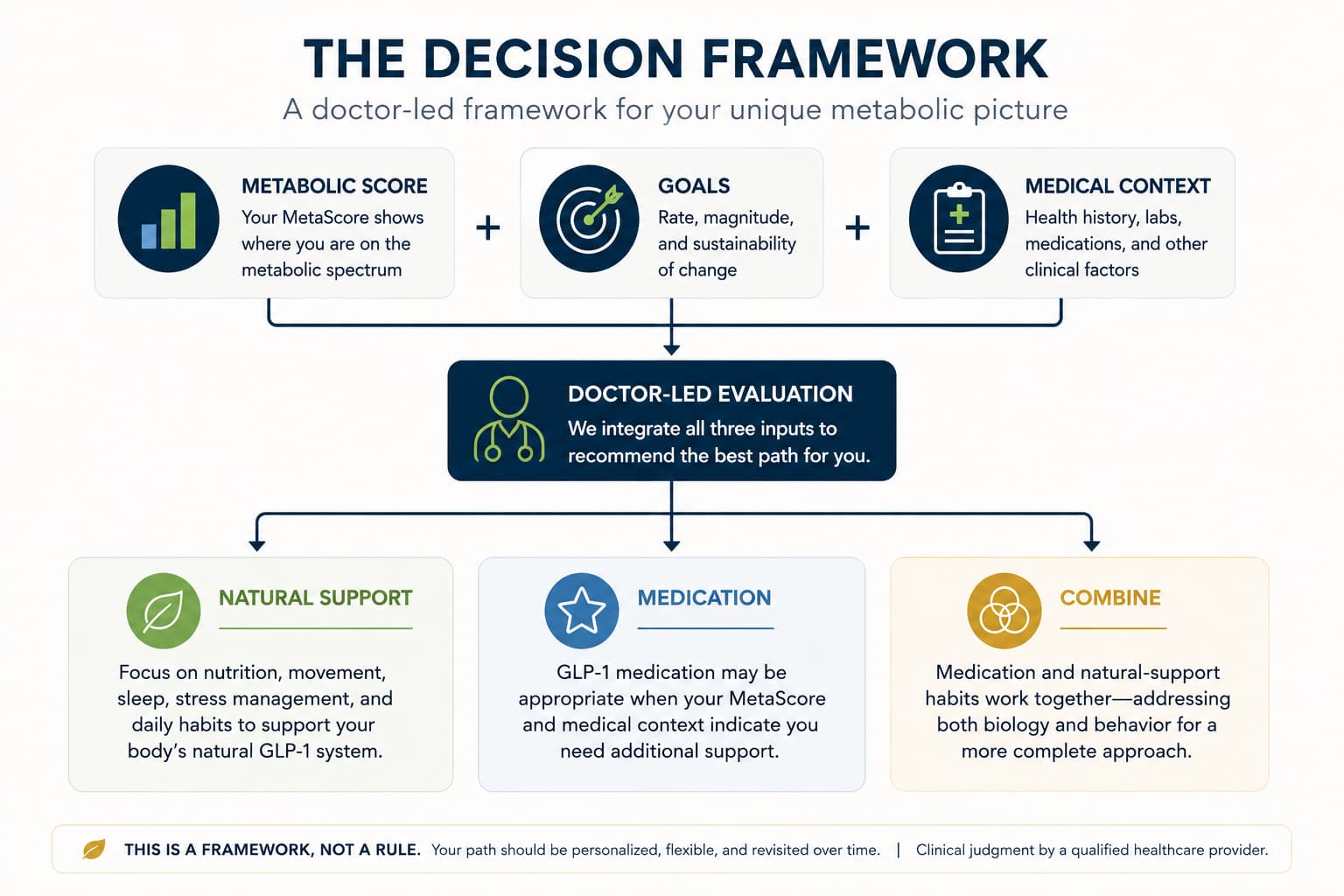
It’s Not Either/Or
In practice, a lot of people don’t pick a single lane. Someone starting a GLP-1 medication still needs the protein and fiber habits that protect muscle and support their own GLP-1 signaling — the medication doesn’t replace good nutrition, it works alongside it. Someone managing things naturally might reach a point where their Metabolic Score or their doctor’s assessment suggests medication would help more than habits alone can. We cover how to combine the two, and what natural support looks like specifically for someone already on medication, in a dedicated companion piece.
Objections and Fears, Answered Honestly
A few concerns come up constantly, and they deserve straight answers rather than reassurance for its own sake. Rebound after stopping medication is real and well-documented — in the STEP 1 trial extension, participants who stopped semaglutide regained roughly two-thirds of their lost weight within a year of discontinuation. [6] That’s not a reason to avoid medication; it’s a reason to plan the natural-support habits that sustain results before you ever consider stopping — we cover that in detail on our stopping-GLP-1 page.
“Is natural support even serious, or is it just marketing?” The mechanisms are real and published — protein, fiber, and post-meal walking all have measurable effects on your own GLP-1 signaling and blood sugar response. What natural support isn’t is a substitute for medical evaluation when your metabolic picture calls for more than habits alone can deliver. Neither path is more “legitimate” than the other; they’re suited to different starting points.
What to Do Now
You don’t have to guess which column of that table you’re in. The free BeyondGLP Metabolic Assessment maps your Metabolic Score across five domains — the same information Dr. Gabriel would want before recommending a path — and gives you a starting point built on your own numbers, not a generic quiz result. For the bigger picture on supporting your own signaling, the glp-1-support pillar ties these pieces together.
Common Questions
Can I get results without medication?
For mild-to-moderate metabolic scores, natural support — protein, fiber, post-meal movement — has real, published mechanisms behind it and can meaningfully shift appetite signals and blood sugar response. Whether it’s sufficient for you specifically depends on your Metabolic Score and medical context, which is exactly what the assessment and a conversation with your doctor are for. [3]
Is natural support less effective?
It’s smaller in scale, not less real. Medications amplify your own GLP-1 signal for hours or days rather than minutes, which is why the measured effect sizes are larger in trials. Natural support works on the same biology with a gentler, slower effect — the right comparison isn’t “effective vs. not,” it’s “how much change do you need, and how fast.” [2]
How do I know which path is right for me?
Start with your Metabolic Score. It maps the same domains — severity, appetite signals, blood sugar, medical context — that inform this decision in clinic, and from there a conversation with your physician can confirm the right path for your specific history.
Scientific References
- Drucker DJ. Mechanisms of Action and Therapeutic Application of Glucagon-like Peptide-1. Cell Metab. 2018;27(4):740–756.
- Wilding JPH, Batterham RL, Calanna S, et al. Once-Weekly Semaglutide in Adults with Overweight or Obesity (STEP 1). N Engl J Med. 2021;384(11):989–1002.
- Tolhurst G, Heffron H, Lam YS, et al. Short-Chain Fatty Acids Stimulate Glucagon-Like Peptide-1 Secretion via the G-Protein–Coupled Receptor FFAR2. Diabetes. 2012;61(2):364–371.
- Watkins JD, Koumanov F, Gonzalez JT. Protein- and Calcium-Mediated GLP-1 Secretion: A Narrative Review. Adv Nutr. 2021;12(6):2540–2552.
- Karakasis P, Patoulias D, Fragakis N, Mantzoros CS. Effect of glucagon-like peptide-1 receptor agonists and co-agonists on body composition. Metabolism. 2025;164:156113.
- Wilding JPH, Batterham RL, Davies M, et al. Weight regain and cardiometabolic effects after withdrawal of semaglutide: The STEP 1 trial extension. Diabetes Obes Metab. 2022;24(8):1553–1564.
You don’t have to guess which column you’re in. The Metabolic Score tells you where to start.
Take the free BeyondGLP Metabolic Assessment →Educational content only. Information explains physiology and is not intended as medical advice. Always consult a qualified healthcare provider regarding medical decisions.