What to Eat on a GLP-1: A Doctor-Led Guide
A smaller appetite means what you eat matters more, not less.
Written by BeyondGLP Editorial Team · Medically reviewed by Dr. Gabriel, MD
Key Takeaways
- On a GLP-1, appetite drops and fullness comes faster — which means what you eat matters more, not less, because there’s less room for food that isn’t doing real work.
- Protein first, at every meal, is the single highest-leverage habit — both for satiety and for protecting the muscle mass a GLP-1 puts at risk. [1][2]
- Fiber and hydration support your own GLP-1 signaling and help manage the digestive side effects that come with a slower-emptying stomach. [3]
- Smaller, more frequent meals tend to work better with a smaller stomach capacity than three large meals forced into a reduced appetite.

From Dr. Gabriel
The mistake I see most often on a GLP-1 is treating the smaller appetite as permission to eat less carefully, when it’s actually the opposite. You have less room, so every bite needs to be doing more — protein for muscle, fiber for digestion and your own signaling, real food over convenience food. This isn’t about eating less. It’s about making the calories you do eat count for something.
A GLP-1 medication does exactly what it’s designed to do: it slows your stomach down and makes you feel full on less food. That’s the point for most people who start one. But it creates a real tension worth naming directly — a smaller appetite combined with a large calorie deficit means less room for foods that don’t earn their place, and a documented risk that some of what you lose is muscle, not fat. [2] Eating well on a GLP-1 isn’t optional or secondary to the medication — it’s what determines whether the weight you lose is mostly fat or a meaningful share of muscle.
The Principles
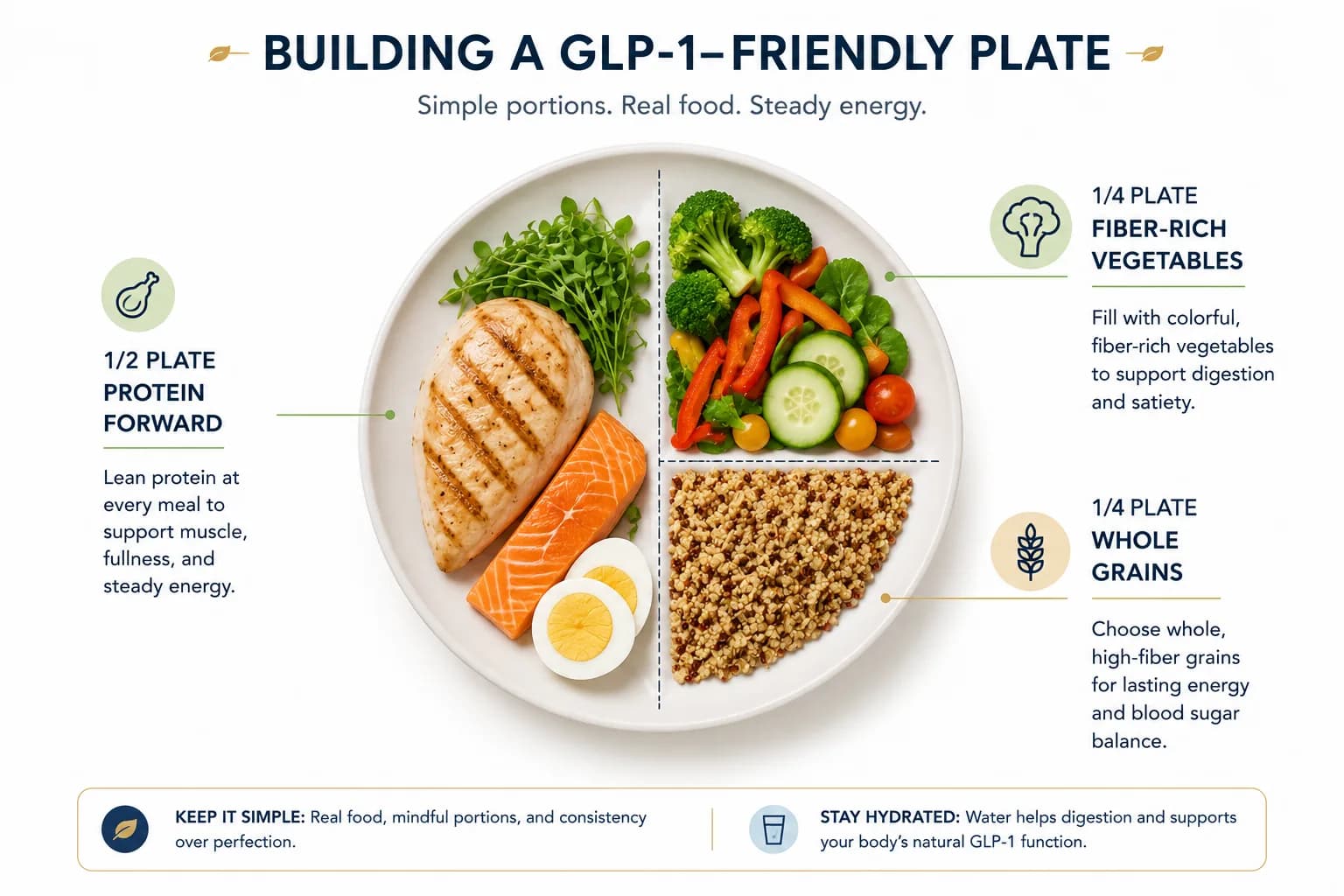
Four things do most of the work. Protein first, at every meal — aim to eat your protein source before anything else on the plate, since appetite drops fast and you want the highest-value food consumed while there’s still room. Fiber, for two reasons: it supports digestion (constipation is one of the most common GLP-1 side effects) and it stimulates your own GLP-1 release through short-chain fatty acid production in the gut. [3] Hydration, because reduced food intake often means reduced fluid intake too, and dehydration compounds nausea and fatigue. And smaller, more frequent meals — three large meals forced into a stomach that empties more slowly tends to produce more discomfort than four or five smaller ones spread through the day.
If you’d rather not plan this from scratch every night, our free recipe guide puts twenty-one protein-first meals on one printable list.
The specific numbers — how much, and from which foods — are on our free one-page fiber cheat sheet.
What to Eat / What to Limit
In practical terms: build meals around a palm-sized portion of protein (chicken, fish, eggs, Greek yogurt, tofu, legumes), add a source of fiber (vegetables, beans, whole grains), and treat refined carbohydrates and highly processed snacks as the first thing to scale back — not because of calories specifically, but because they crowd out the protein and fiber doing the actual work, and they tend to spike and crash blood sugar in a way that can worsen the fatigue some people feel on a GLP-1.
This isn’t a calorie-counting exercise. It’s a quality-first approach: given that you’re eating less overall, what you eat needs to work harder — appetite signals and satiety matter more here than a specific calorie target.
Protecting Muscle
This is worth repeating because it’s the part most food advice skips: a 2025 meta-analysis of 22 randomized trials found that roughly a quarter of total weight lost on GLP-1 therapy was lean mass, not fat. [2] Protein intake is the most directly actionable lever you have against that. We go deeper on the full picture — including resistance training — on our dedicated muscle-loss page; this page focuses specifically on the food side of that equation.
A Sample Day
A practical shape, not a rigid template: a protein-forward breakfast (eggs, Greek yogurt, or a protein smoothie), a light, fiber-rich lunch built around a lean protein and vegetables, a small protein-and-fiber snack if appetite allows mid-afternoon, and a dinner that mirrors lunch in structure but can be lighter depending on how the day’s appetite has gone. The exact foods matter less than the pattern: protein anchoring each eating occasion, fiber alongside it, and portions that respect how much room is actually there. Our recipes section has several options built around exactly this structure.
What to Do Now
The general principles above apply broadly, but your own appetite signals, digestion, and energy are specific to you. The free BeyondGLP Metabolic Assessment can help personalize this into an actual plan rather than general guidance.
Common Questions
What should I eat first on a GLP-1?
Protein, before anything else on the plate. Appetite and fullness arrive faster on a GLP-1, so eating your protein source first makes it more likely you actually get enough of it before you’re full. [1]
How much protein do I need?
General guidance circulating widely suggests roughly 25–30 grams of protein per meal supports satiety, though this isn’t drawn from a single citable prescription and should be personalized — the assessment and your doctor can help tailor a specific target to your situation. [1]
What foods should I limit?
Not a specific forbidden list, but a general principle: refined carbohydrates and highly processed snacks tend to crowd out the protein and fiber doing the real work, and can worsen blood sugar swings and fatigue. Scaling those back, rather than eliminating them entirely, tends to be more sustainable.
Scientific References
- Leidy HJ, Clifton PM, Astrup A, et al. The role of protein in weight loss and maintenance. Am J Clin Nutr. 2015;101(6):1320S–1329S.
- Karakasis P, Patoulias D, Fragakis N, Mantzoros CS. Effect of glucagon-like peptide-1 receptor agonists and co-agonists on body composition. Metabolism. 2025;164:156113.
- Tolhurst G, Heffron H, Lam YS, et al. Short-Chain Fatty Acids Stimulate Glucagon-Like Peptide-1 Secretion via the G-Protein–Coupled Receptor FFAR2. Diabetes. 2012;61(2):364–371.
- Bellini A, Nicolò A, Bazzucchi I, Sacchetti M. The Effects of Postprandial Walking on the Glucose Response after Meals with Different Characteristics. Nutrients. 2022;14(5):1080.
Personalize your plan with the Metabolic Score.
Take the free BeyondGLP Metabolic Assessment →Educational content only. Information explains physiology and is not intended as medical advice. Always consult a qualified healthcare provider regarding medical decisions.