Signs of Poor Metabolic Health: What Your Body Is Telling You
The early signals of metabolic dysfunction rarely feel like a medical problem. They feel like a normal part of life.
Written by Dr. Steven Gabriel, MD · Board-Certified Emergency Physician · June 2026
Key Takeaways
- The early signs of poor metabolic health — afternoon energy crashes, persistent cravings, poor sleep, weight that shifts around the waistline — are often dismissed as stress or ageing rather than recognised as metabolic signals.
- These symptoms frequently appear years before any clinical marker crosses a diagnostic threshold, because metabolic dysfunction develops slowly across all five signal domains.
- According to the Centers for Disease Control and Prevention, cardiometabolic risk factors are widespread in the US adult population — including in people who appear outwardly well.
- Recognising these patterns early is where intervention is most effective — before they become diagnoses.
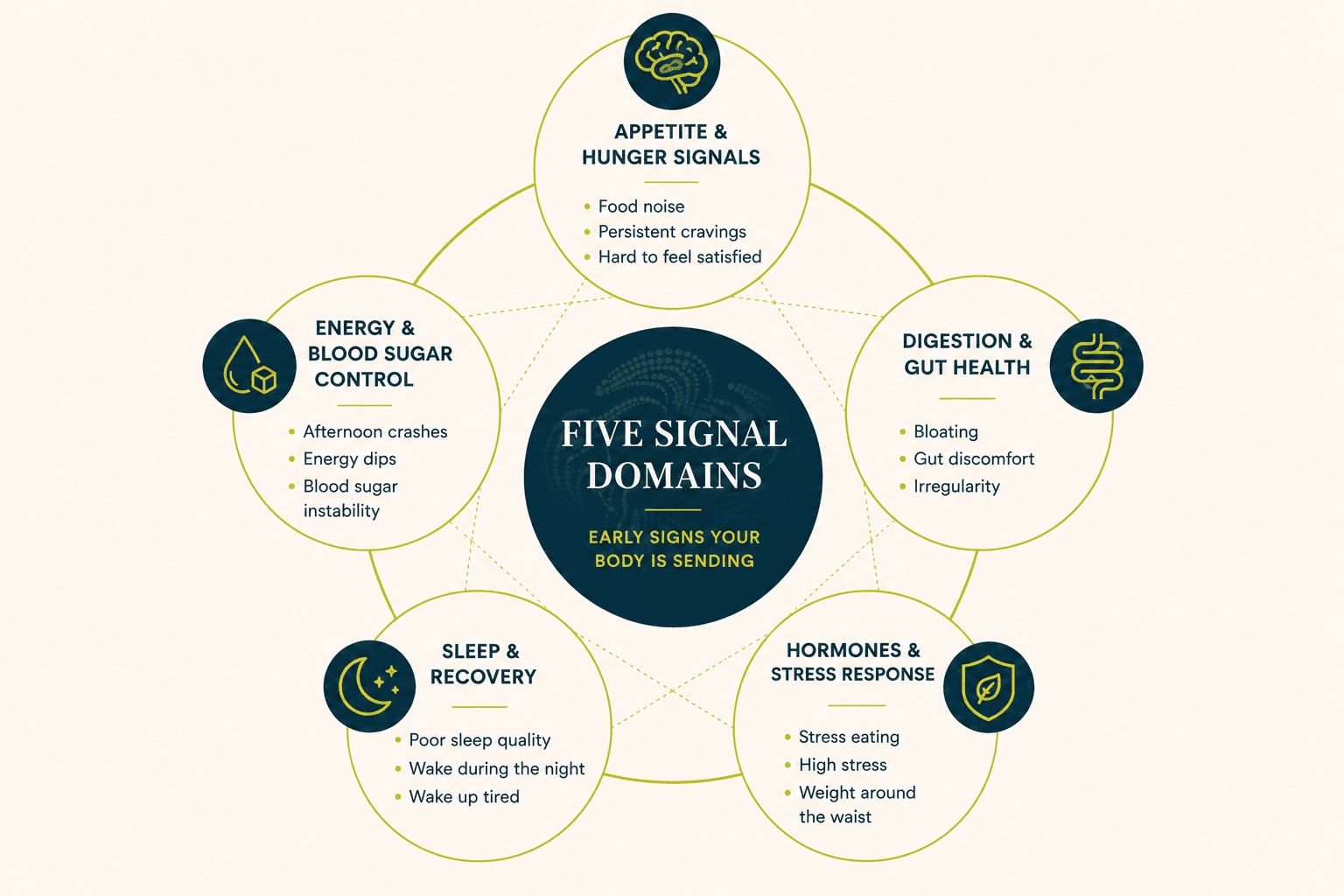
- The BeyondGLP Metabolic Assessment evaluates all five signal domains — Appetite & Hunger Signals, Energy & Blood Sugar Control, Digestion & Gut Health, Sleep & Recovery, and Hormones & Stress Response — to identify which signals may be under strain.

From Dr. Gabriel
“The patients I worry about most are not the ones who look unwell. I worry about people who look well, but have a hidden metabolic syndrome…A silent killer. Their labs were normal at their last physical. They have the afternoon crash that everyone jokes about needing coffee for. The cravings that feel like a character flaw. The weight that has slowly moved to the mid section over the last three years. The sleep that technically happens but never fully restores. These are not random inconveniences. They are a biological system signalling that something needs attention — and learning to read these signals is the difference between catching a problem early and waiting until the consequences are unavoidable.”
Most people do not experience poor metabolic health as a disease. They experience it as a collection of annoyances that feel vaguely familiar, slightly worse than they used to be, and easy to explain away. The energy crash after lunch. The craving that arrives at 3pm on schedule. The restless night that leaves the morning feeling unfinished. The waist measurement that has been quietly increasing for two or three years.
These experiences are not unrelated. They are the same underlying biology expressing itself across different signal domains. Metabolic health describes how well five interconnected systems function together — and when one begins to decline, the others typically follow. Understanding what these signs mean, and why they cluster the way they do, is the first step toward addressing them.
What does poor metabolic health actually feel like?
Poor metabolic health presents as a pattern, not a single symptom.
The clinical picture of metabolic dysfunction is a cluster of overlapping experiences that tend to intensify gradually over months or years. No single one of them is alarming on its own. Together, they describe a system under increasing strain.
According to the Centers for Disease Control and Prevention, cardiometabolic risk factors are widespread across the US adult population — and they are not confined to people who are overweight, visibly unwell, or receiving clinical intervention. Many of the people with the most significant underlying dysfunction are the ones who have been told, repeatedly, that their bloodwork looks fine.
Energy crashes and blood sugar instability
Afternoon energy collapse — the heavy fatigue and difficulty concentrating that arrives 90 to 120 minutes after a meal — is one of the most consistent and recognisable early signs of impaired blood sugar regulation.
When blood sugar rises sharply after a meal and the body’s insulin response overcorrects, glucose drops below the stable range before returning to baseline. The result is a brief window of cellular energy deficit that the brain experiences as sudden fatigue, difficulty focusing, and an urgent drive toward quick-release carbohydrates or caffeine. This is not tiredness caused by insufficient sleep. It is blood sugar instability expressing itself as an energy signal.
A meta-analysis of 22 prospective cohort studies found that adults with the highest fasting insulin levels — one of the earliest measurable markers of this process — had a 63% higher risk of hypertension and a 50% higher risk of coronary heart disease than those with the lowest levels (Xun P, Wu Y, He Q, He K, American Journal of Clinical Nutrition, 2013 — PMID 24132974) [2]. The energy crash at 3pm is not a minor inconvenience. It is a signal from the Energy & Blood Sugar Control domain that something is trending wrong.
Persistent cravings and food noise
Hunger that arrives before a meal makes sense. Hunger that persists after a full meal, or cravings for specific foods — particularly sweet or starchy foods — that arrive independent of actual caloric need, do not.
This experience — commonly described as food noise — is a symptom of disrupted appetite signalling. When insulin resistance impairs GLP-1 function and leptin sensitivity, the hormonal signals that govern fullness become blunted. The brain does not receive a reliable satiety signal, so hunger remains elevated even when the body has adequate nutrition. Ultra-processed food consumption compounds this by promoting insulin resistance, which further disrupts the appetite-regulating GLP-1 system (Drucker, Cell Metabolism, 2018 — PMID 29617641) [4].
The experience of craving sugar, carbohydrates, or specific palatable foods after eating a full meal is not a failure of discipline. It is the Appetite & Hunger Signals domain functioning poorly.
Changing body composition — especially around the waist
Weight is not a reliable signal of metabolic health. But changing body composition — particularly the redistribution of fat from peripheral to central locations — is one of the most consistent early physical signs of metabolic dysfunction.
Visceral fat — fat stored around the abdominal organs rather than beneath the skin — is metabolically active in ways subcutaneous fat is not. It secretes inflammatory cytokines, impairs insulin signalling, and accelerates the progression of metabolic dysfunction independently of total body weight. A cross-sectional analysis of 8,721 US adults found that poor metabolic health appeared across all BMI categories, including individuals of normal weight (Araújo et al., Metabolic Syndrome and Related Disorders, 2019 — PMID 30484738) [1].
The practical sign: clothes fitting differently around the waist, a belt notch moving, or a waist measurement that has been slowly increasing over one to three years — even when weight on the scale has remained relatively stable. This is visceral fat accumulation, and it is a more sensitive early signal than total body weight.
Sleep that does not restore
Poor sleep quality — waking unrested despite adequate hours — is both a symptom and a driver of metabolic dysfunction. The relationship is bidirectional and compounds quickly.
Sleep deprivation acutely suppresses GLP-1 secretion, elevates ghrelin (the hunger hormone), and increases insulin resistance the following day. This means a poor night of sleep directly impairs appetite signalling and blood sugar regulation the morning after — amplifying cravings and energy instability in a self-reinforcing pattern. The Sleep & Recovery signal domain is not peripheral to metabolic health. It is a direct regulatory input to every other domain.
The signs: waking during the night, feeling unrested after seven to eight hours, needing more sleep than felt necessary in earlier years, or experiencing energy patterns that feel disconnected from how much sleep was achieved. These are not simply habits to improve. They are metabolic signals worth taking seriously.
Stress-driven eating and cortisol patterns
Eating in response to stress — particularly strong cravings for dense, calorie-rich foods under pressure — is a physiological response to cortisol, not a behavioural failure.
Cortisol elevates blood sugar directly, drives cravings for high-fat and high-carbohydrate foods, and promotes visceral fat deposition independently of diet. Chronic psychological stress also impairs GLP-1 output and blunts insulin sensitivity. The Hormones & Stress Response domain influences every other signal domain — when it is dysregulated, appetite, energy, and sleep signals all suffer downstream.
The signs: eating differently under stress than under calm, food choices that shift toward highly palatable foods when tired or under pressure, or an awareness that emotional state significantly drives food intake. These are not willpower problems. They are hormonal responses worth understanding.
Signs that appear in blood markers — but are often missed
Not all signs of metabolic dysfunction are experiential. Several appear in standard bloodwork but are not routinely flagged or discussed.
Triglyceride-to-HDL ratio above 2
This ratio — calculated from numbers that appear in any standard lipid panel — is one of the most accessible and informative indicators of insulin resistance. A ratio above 2 (triglycerides divided by HDL) correlates strongly with elevated fasting insulin and visceral fat accumulation in prospective cohort research. Most clinicians do not mention it unless one of the individual values is individually abnormal.
Fasting blood glucose in the 90–99 mg/dL range
This is within the normal range. It is also trending toward prediabetes. Insulin resistance develops gradually, over a period of years, through mechanisms like ectopic lipid accumulation and chronic inflammation (Petersen & Shulman, Physiological Reviews, 2018, PMID 30067154) — with fasting glucose in the high-normal range representing a meaningful point on that trajectory. "Normal" and "optimal" are not the same number.
Waist circumference above 88 cm (women) or 102 cm (men)
This measurement does not appear in most standard bloodwork, but it is one of the five criteria for metabolic syndrome as defined by the American Heart Association. It is the most directly measurable sign of visceral fat accumulation — and it is almost never measured at a standard annual physical.
How the five signal domains connect
These signs are not unrelated symptoms. They are the same underlying metabolic system expressing itself across five domains simultaneously.
When Energy & Blood Sugar Control is impaired, blood sugar instability produces afternoon crashes and drives cravings. When Appetite & Hunger Signals are disrupted, food noise intensifies and satiety becomes unreliable. When Digestion & Gut Healthis compromised, GLP-1 production falls and the gut’s regulatory capacity declines. When Sleep & Recovery is poor, cortisol rises and insulin sensitivity worsens the next morning. When Hormones & Stress Response are chronically elevated, every other domain is impaired downstream.
The cluster is the signal. One or two of these experiences in isolation may be coincidental. Three or more appearing together, over months, is a metabolic pattern worth addressing.
How to know where you stand
A standard annual physical captures fasting glucose and basic lipids. It does not routinely assess fasting insulin, waist circumference, or the non-lab signal domains — appetite, digestion, sleep quality, and stress hormone patterns — that reflect the earliest stage of metabolic change.
The BeyondGLP Metabolic Assessment evaluates all five signal domains — Appetite & Hunger Signals, Energy & Blood Sugar Control, Digestion & Gut Health, Sleep & Recovery, and Hormones & Stress Response — through a structured self-reported profile, producing a personalised Metabolic Score that identifies which signals may need attention and in what order. It does not replace clinical evaluation or laboratory testing. It is a starting point.
Free · Physician-reviewed · Results in under 5 minutes
Common Questions
Can you have poor metabolic health without feeling unwell?
Yes. Metabolic dysfunction often develops silently for years before producing recognisable symptoms. Many of the most common early signals — mild fatigue, occasional cravings, modest waist changes — are easy to normalise. Only 12.2% of US adults meet all criteria for optimal metabolic health (Araújo et al., PMID 30484738), which means the majority of people with meaningful metabolic dysfunction do not currently feel acutely unwell.
Is afternoon fatigue always a sign of poor metabolic health?
Not necessarily — poor sleep, dehydration, and other factors can cause afternoon fatigue. But afternoon energy crashes that arrive reliably 90 to 120 minutes after meals, feel relieved by sugar or caffeine, and occur consistently over weeks or months are a strong pattern signal of blood sugar instability, not random tiredness.
Do these signs look different in women?
Yes, particularly during perimenopause and menopause. The rise in visceral fat and changes in GLP-1 signalling that accompany the hormonal transition of menopause produce a distinct cluster of signs: changing body composition around the waist independent of diet, increased appetite and food noise, and energy instability that was not previously present. These are biological changes, not discipline failures.
Is food noise the same as emotional eating?
They overlap but are not the same. Emotional eating describes using food for psychological regulation — a behavioural pattern. Food noise describes the persistent, intrusive experience of thinking about food between meals when not hungry — a neurological and hormonal symptom of disrupted GLP-1 function and appetite signalling. Both may be present simultaneously, but they have different biological drivers and different implications.
When should these signs prompt a visit to a clinician?
The signs described here are educational context, not diagnostic criteria. If you are experiencing persistent energy crashes, significant changes in body composition, or sleep disruption, discussing them with a qualified clinician — ideally one who will assess fasting insulin and waist circumference alongside standard bloodwork — is worthwhile. The BeyondGLP Metabolic Assessment can help you understand your signal profile before that conversation.
Scientific References
- 1.Araújo J, Cai J, Stevens J. Prevalence of optimal metabolic health in American adults: National Health and Nutrition Examination Survey 2009–2016. Metabolic Syndrome and Related Disorders, 2019. PMID 30484738.
- 2.Xun P, Wu Y, He Q, He K. Fasting insulin concentrations and incidence of hypertension, stroke, and coronary heart disease: a meta-analysis of prospective cohort studies. American Journal of Clinical Nutrition, 2013. PMID 24132974.
- 3.Petersen MC, Shulman GI. Mechanisms of Insulin Action and Insulin Resistance. Physiological Reviews, 2018. PMID 30067154.
- 4.Drucker DJ. Mechanisms of action and therapeutic application of glucagon-like peptide-1. Cell Metabolism, 2018. PMID 29617641.
- 5.Centers for Disease Control and Prevention. Adult Obesity Facts.
Educational only. This page is for general education and is not medical advice, diagnosis, or treatment. Always consult a qualified healthcare provider regarding medical decisions. No outcomes are promised — individual results vary; nothing here guarantees weight loss or any specific health outcome. The BeyondGLP Metabolic Assessment is an educational metabolic profile, not a diagnostic device. Reviewed by Dr. Steven Gabriel MD on June 2026.