Foods and Habits That Support Metabolic Health
There is no single metabolic diet. There are evidence-based eating patterns — and they share more in common than the noise suggests.
Written by Dr. Steven Gabriel, MD · Board-Certified Emergency Physician · June 2026
Key Takeaways
- No single food "boosts metabolism." Eating patterns associated with metabolic health share consistent characteristics: high protein, adequate fibre, minimal ultra-processed food, and a structure that supports blood sugar stability.
- Protein is the most metabolically significant macronutrient — it stimulates GLP-1 secretion, supports muscle mass preservation, and produces the most reliable satiety signal per calorie.
- Movement that builds or preserves skeletal muscle — resistance exercise — addresses the primary biological driver of metabolic slowdown more directly than cardiovascular exercise alone.
- Sleep quality and stress management are not lifestyle add-ons. They are direct metabolic inputs that affect GLP-1 function, insulin sensitivity, and appetite signalling.
- The BeyondGLP Metabolic Assessment identifies which of your five signal domains — Appetite & Hunger Signals, Energy & Blood Sugar Control, Digestion & Gut Health, Sleep & Recovery, and Hormones & Stress Response — needs the most support, so you know where to start.

From Dr. Gabriel
“Every week there is a new study, a new protocol, a new headline about the optimal metabolic diet. Carnivore. Mediterranean. Keto. Intermittent fasting. My patients are exhausted trying to reconcile them. What I tell them is this: the evidence base is actually more consistent than the headlines suggest. High-quality protein. Adequate fibre. Food that doesn’t spike your blood sugar repeatedly across the day. Movement that preserves muscle. Sleep that actually restores. Stress that doesn’t run chronically elevated. None of that is controversial. The question is which of those levers is most important for you, at this point in your metabolic health journey. That answer is different for a 45-year-old woman in perimenopause than for a 38-year-old man with high-stress work and poor sleep. The framework matters. The personalisation matters more.”
The question of what to eat for metabolic health generates more noise than almost any other topic in nutrition. Every month produces new claims, new protocols, and new systems that position themselves as the definitive answer. The evidence base is actually more consistent than the noise suggests. According to Harvard T.H. Chan School of Public Health’s Nutrition Source, the eating patterns most consistently associated with metabolic health share common characteristics — and those characteristics are more important than any specific dietary label. This article covers those patterns, the habits that support them, and why personalisation — understanding which of your five signal domains needs the most support — determines which levers matter most for you.
Why there is no single “metabolic diet”
Metabolic health is determined by five signal domains — appetite, energy, digestion, sleep and recovery, and stress hormones — and the dietary and lifestyle factors that support each domain overlap significantly but are not identical.
A protocol optimised for blood sugar stability (low glycaemic index, high fibre, protein-first meals) may differ in its specifics from a protocol optimised for GLP-1 production (fermented foods, specific polyphenol-rich plants, probiotic support). A protocol optimised for someone with elevated cortisol and poor sleep requires different prioritisation than one optimised for someone with good sleep and poor dietary structure.
The American Heart Association recommends dietary patterns — not specific diets — as the evidence-based framework for metabolic health support [3]. The consistency across the evidence base points not to a single protocol but to shared characteristics that appear across eating patterns associated with better metabolic markers.
Protein: the most metabolically significant macronutrient
Of the three macronutrients, protein has the most direct and consistent relationship with metabolic health outcomes — and it is almost universally under-consumed relative to what the evidence supports.
Protein and GLP-1
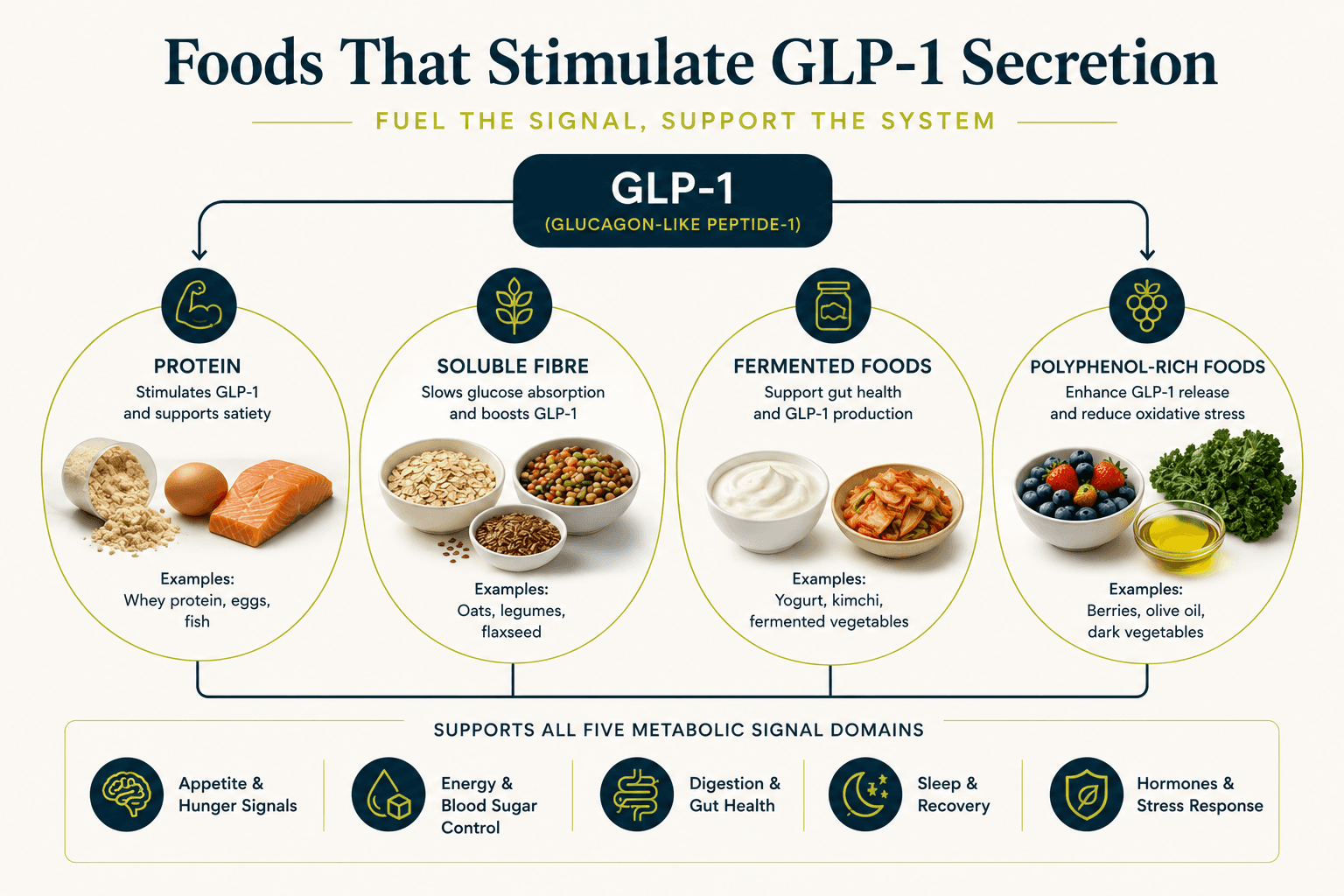
Protein — particularly whey protein and other animal proteins — is one of the strongest stimulants of GLP-1 secretion from gut L-cells. A randomized controlled trial published in Gut (2015) found that delivering propionate, a short-chain fatty acid produced when fibre ferments in the colon, directly to the colon increased GLP-1 and PYY release, reduced energy intake, and supported weight maintenance over 24 weeks (Chambers et al., Gut, 2015 — PMID 25500202) [1]. Prioritising protein and fermentable fibre at meals supports the gut's capacity to produce the satiety signal that governs hunger between meals.
Protein and blood sugar
Protein slows gastric emptying and blunts the glycaemic response to carbohydrates consumed in the same meal. A protein-first eating strategy — eating the protein component of a meal before the carbohydrate component — is one of the most accessible and evidence-consistent tools for reducing post-meal blood sugar spikes.
Protein and muscle mass
Skeletal muscle is the primary site of insulin-mediated glucose uptake and the primary driver of resting metabolic rate. Preserving muscle mass with age requires adequate dietary protein alongside resistance exercise. The combination of progressive resistance training and adequate protein intake is the most evidence-supported approach to addressing the muscle loss that drives metabolic slowdown. Practical target: 1.6–2.2g of protein per kilogram of body weight per day is the range most consistently associated with muscle preservation in adults over 40. This is a general educational reference — individual needs vary and clinical guidance applies.
Fibre: the gut-metabolic connection
Dietary fibre — particularly soluble fibre from whole plant foods — supports metabolic health through two primary mechanisms: slowing glucose absorption (reducing post-meal blood sugar spikes) and feeding the gut microbiome bacteria that produce short-chain fatty acids and stimulate GLP-1 secretion.
The same trial cited above found that the short-chain fatty acids produced when fibre ferments in the colon stimulated GLP-1 secretion [1]. Viscous soluble fibres from oats, legumes, flaxseed, and psyllium are among the most consistently studied. Fermentable fibres from a diverse range of vegetables, legumes, and whole grains support microbiome diversity — which directly influences the gut’s capacity to regulate appetite, produce GLP-1, and modulate inflammation.
The practical implication: eating patterns that include a wide variety of whole plant foods — not as a moral position, but as a structural support for gut health and GLP-1 function — consistently appear in the evidence base associated with better metabolic markers.
Hitting the fibre target is the part most people find vague, so we put the numbers and the food sources on a single printable sheet.
Ultra-processed foods and metabolic disruption
Ultra-processed foods are not merely “unhealthy.” They actively disrupt the metabolic signal domains in ways that whole foods do not — and understanding the mechanism helps explain why the disruption is so consistent.
Ultra-processed foods are engineered to reduce satiety signals while maximising palatability. They are low in protein, fibre, and the food matrix components that slow digestion and trigger GLP-1 secretion. They are high in refined carbohydrates, industrially processed fats, and additives that accelerate gastric emptying — producing rapid blood sugar spikes followed by rapid crashes.
The result is a dietary pattern that consistently impairs the Appetite & Hunger Signals and Energy & Blood Sugar Control domains. The food noise experience — persistent hunger between meals — is not a character trait of the people eating ultra-processed diets. It is a biological consequence of eating patterns that systematically suppress GLP-1 function.
Movement that supports metabolic health
Not all exercise has the same metabolic effect — and for most adults over 35, the type of movement that most directly addresses metabolic slowdown is resistance exercise, not cardiovascular exercise alone.
Resistance exercise and muscle preservation
Skeletal muscle is lost at approximately 3–5% per decade from age 30. Resistance exercise — progressive loading that challenges muscle to adapt — is the only reliable stimulus for muscle protein synthesis that preserves or builds metabolically active tissue. This is why the American Heart Association includes resistance exercise in its lifestyle recommendations for metabolic health, not just cardiovascular activity.
Walking after meals
A 10–15 minute walk after a meal significantly reduces the post-meal blood sugar spike by increasing glucose uptake in muscle tissue. This is one of the most accessible single habits for supporting the Energy & Blood Sugar Control domain — it requires no equipment and has consistent evidence support.
The combination effect
The metabolic benefit of exercise is substantially greater when combined with adequate protein intake. Exercise without sufficient protein to support muscle protein synthesis produces cardiovascular benefit without meaningfully addressing the muscle loss that drives declining metabolic rate.
Sleep as a metabolic habit
Sleep is not a lifestyle preference that influences metabolic health at the margins. It is a direct regulatory input to four of the five signal domains.
Adequate sleep — seven to nine hours of quality sleep for most adults — restores GLP-1 secretion, normalises ghrelin levels, and resets insulin sensitivity overnight. A single night of poor sleep measurably impairs appetite signalling and blood sugar regulation the following day. Chronic sleep disruption accelerates the metabolic changes associated with ageing in ways that dietary and exercise habits alone cannot compensate for.
The practical implication: addressing sleep quality is not a secondary consideration once eating and exercise are optimised. It is a primary metabolic lever — and for many adults, it may be the highest-yield single change available.
Stress management as metabolic medicine
Chronic cortisol elevation is not a psychological problem with metabolic side effects. It is a direct metabolic disruption that elevates blood sugar, promotes visceral fat deposition, impairs insulin sensitivity, and blunts GLP-1 output.
Practices that reduce the activation of the stress response — sleep, physical movement, time in nature, social connection, deliberate rest — are not wellness add-ons. They are interventions in the Hormones & Stress Response signal domain that have measurable downstream effects on every other domain.
This is particularly relevant for midlife adults whose metabolic changes are occurring in parallel with elevated work, caregiving, and life-stage stress. For this group, stress management may be as metabolically significant as any dietary change.
How to know which habits matter most for you
The habits described here all have evidence support. Not all of them are equally important for every person at every stage. Prioritising protein intake may be the highest-yield change for someone with adequate sleep and managed stress. Addressing sleep quality may produce more metabolic benefit than dietary changes for someone who sleeps five to six hours. Managing cortisol may be the primary driver of metabolic difficulty for someone under sustained work or life stress.
The BeyondGLP Metabolic Assessment evaluates all five signal domains — Appetite & Hunger Signals, Energy & Blood Sugar Control, Digestion & Gut Health, Sleep & Recovery, and Hormones & Stress Response — to identify which signals need the most support and in what order. It does not replace clinical guidance. It provides a personalised starting point.
For a practical starting point, browse BeyondGLP’s recipe library — protein- and fibre-forward meals organised around the same five signal domains.
Free · Physician-reviewed · Results in under 5 minutes
Common Questions
Is there a specific metabolic diet I should follow?
No single dietary label consistently outperforms the shared characteristics of patterns associated with metabolic health: high protein, adequate soluble fibre, minimal ultra-processed food, and a meal structure that supports blood sugar stability. The specific foods that deliver these characteristics vary widely across cultural and personal preferences.
How much protein do I actually need?
The general evidence-based range for adults focused on muscle preservation and metabolic support is 1.6–2.2g per kilogram of body weight per day. This is educational context — individual protein needs vary based on age, activity level, and clinical factors. A clinician or registered dietitian can provide specific guidance for your situation.
Is intermittent fasting metabolically beneficial?
Intermittent fasting has evidence support for blood sugar regulation in some populations, primarily through its effect on reducing overall caloric intake and improving insulin sensitivity. It is not uniquely metabolically beneficial compared to other eating patterns that achieve the same protein intake and blood sugar stability. Whether it suits your appetite signalling, lifestyle, and metabolic profile depends on factors that vary individually.
What foods most directly stimulate GLP-1?
Protein is one of the most direct stimulants of GLP-1 secretion. A randomized controlled trial (Chambers et al., Gut, 2015) also found that short-chain fatty acids produced when fibre ferments in the colon stimulate GLP-1 release. In practice, this points to protein-forward meals — whey protein, legumes — paired with fermentable fibre sources like oats and flaxseed as the most evidence-backed starting point.
Does coffee affect metabolic health?
Moderate coffee consumption — two to four cups per day — is associated with improved insulin sensitivity in several epidemiological studies. Caffeine is also a mild GLP-1 secretagogue. The metabolic effect of coffee depends substantially on what accompanies it — high-sugar additions significantly negate any benefit. This is an area where the evidence is observational rather than mechanistic.
Scientific References
- 1.Chambers ES, Viardot A, Psichas A, et al. Effects of targeted delivery of propionate to the human colon on appetite regulation, body weight maintenance and adiposity. Gut, 2015. PMID 25500202.
- 2.Harvard T.H. Chan School of Public Health — The Nutrition Source. Healthy Eating Plate.
- 3.American Heart Association. Healthy Living — Nutrition, Physical Activity, and Lifestyle Recommendations.
See which of your five signal domains may need attention
Educational only. This page is for general education and is not medical advice, diagnosis, or treatment. Always consult a qualified healthcare provider regarding medical decisions. No outcomes are promised — individual results vary. The BeyondGLP Metabolic Assessment is an educational metabolic profile, not a diagnostic device. Reviewed by Dr. Steven Gabriel MD on June 2026.