Why You Think About Food All Day: The Appetite Signal Behind Food Noise
Your brain isn't undisciplined — it's underinformed.
Written by BeyondGLP Editorial Team · Medically reviewed by Dr. Gabriel, MD
Key Takeaways
- The urge to think about food all day is driven mainly by two systems: the gut-brain satiety signal and blood sugar stability — not by a lack of self-control.
- A hormone called GLP-1, released from your gut, is one of the primary signals telling your brain “you've eaten, you can stop thinking about food now.” When that signal is weak or delayed, the mental loop continues.
- A dip in blood sugar 2–3 hours after a meal is one of the strongest known predictors of feeling hungry again, independent of how much you actually ate.
- Because both systems are physiological, they're something you can work with directly, rather than something you have to white-knuckle through.

From Dr. Gabriel
Patients often describe this to me almost apologetically, like they're confessing something shameful — “I know it's ridiculous, but I can't stop thinking about lunch and it's 10am.” It's not ridiculous. It's your gut-brain signaling doing exactly what physiology predicts it will do under certain conditions. Once patients understand that, the shame usually drops away, and what's left is a solvable problem.
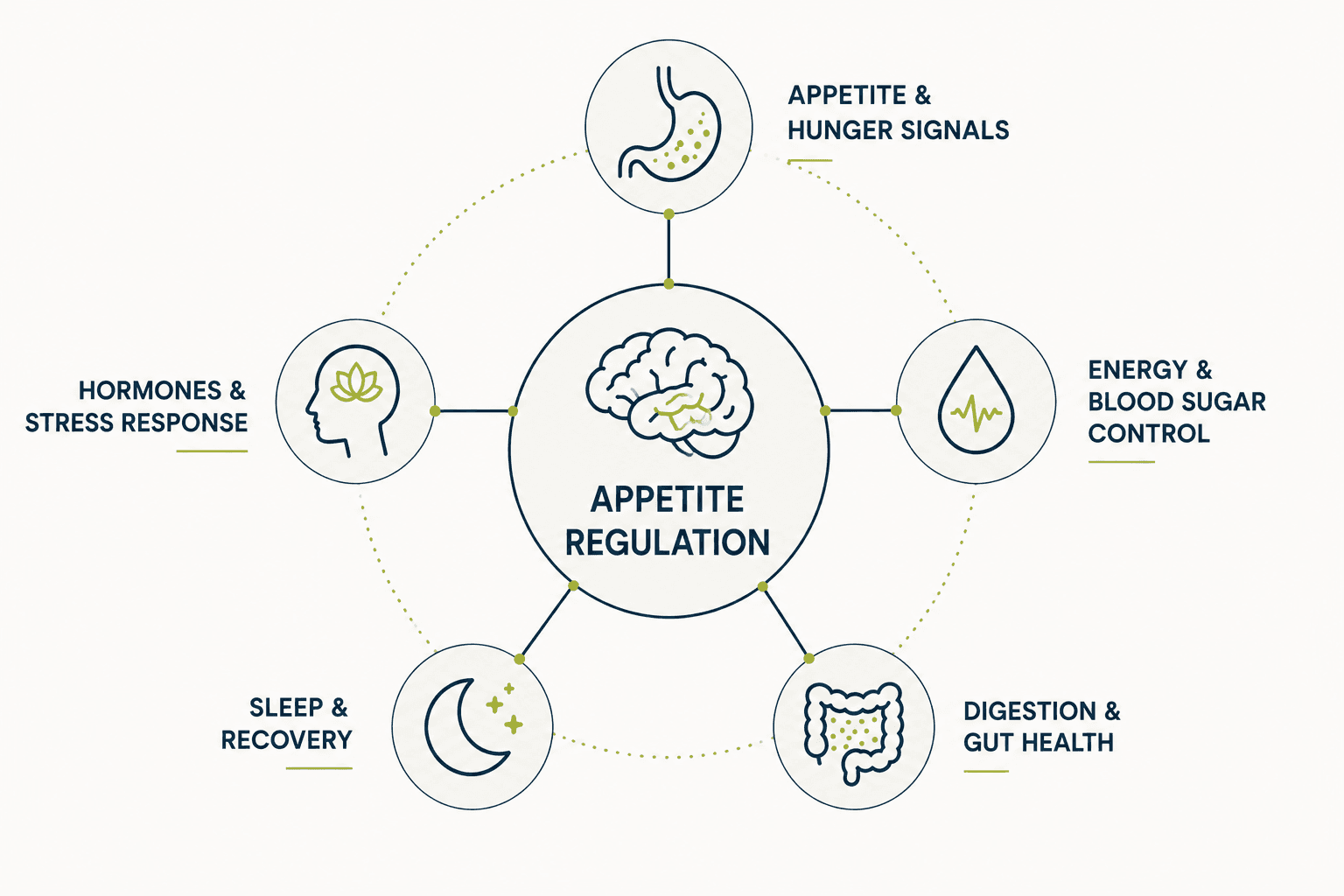
You had breakfast. You're not physically hungry. And yet, by mid-morning, you're already thinking about lunch, or replaying what's in the fridge, or debating whether to have a snack you don't actually want. If this happens most days, you've probably wondered whether something is wrong with your relationship to food. What's actually happening is more mechanical than psychological: two specific physiological systems — gut-brain satiety signaling and blood sugar regulation — are influencing how often and how loudly your brain returns to the subject of food.
What this means in plain English
Your body has a built-in system for telling your brain when you've had enough to eat. When that system is working well, the “you're done” message is clear and thoughts about food fade into the background between meals. When it's not — because of how your gut is signaling, or because your blood sugar is swinging — that message either doesn't land or gets contradicted a couple of hours later, and your brain keeps circling back.
Why this happens biologically
The main messenger in this system is GLP-1, a hormone released by cells in your small intestine within minutes of eating. GLP-1 travels to your brainstem partly via the vagus nerve and partly through the bloodstream, where it acts on receptors in the hypothalamus and other regions involved in appetite control (Drucker, Cell Metabolism, 2018). This is a genuinely two-way conversation between gut and brain, not a one-time chemical dump — and recent work using more precise genetic and viral tracing methods has clarified just how much of this signaling depends on that gut-to-brainstem pathway specifically (Brierley & de Lartigue, British Journal of Pharmacology, 2022). When GLP-1 signaling is robust, it reliably produces that “you're done” feeling. When it's blunted — which can happen with poor sleep, chronic stress, or certain dietary patterns — the signal is weaker, and your brain doesn't get a clean answer.
Blood sugar adds a second layer entirely. A large study that used continuous glucose monitors to track more than a thousand people through thousands of meals found that a dip in blood sugar 2–3 hours after eating was a better predictor of subsequent hunger and increased food intake than how big the meal was in the first place (Wyatt et al., Nature Metabolism, 2021). People with the largest glucose dips reported meaningfully higher hunger, ate again sooner, and consumed more calories over the rest of the day — independent of what or how much they'd eaten. That means you can eat a completely adequate meal and still get hit with a strong “eat something” signal a couple of hours later, purely because of how your blood sugar behaved after that meal.
What you eat can make both of these mechanisms harder to manage. In a tightly controlled NIH inpatient study, researchers gave the same group of adults a diet built from whole foods and a diet built from ultra-processed foods, matched for calories, sugar, fat, and fiber. People eating the ultra-processed diet consumed roughly 500 more calories a day than they did on the whole-food diet, even though nothing about the available calories differed (Hall et al., Cell Metabolism, 2019). That's a meaningful clue that some dietary patterns make it harder for your gut-brain signaling and blood sugar to do their job well, independent of anyone's discipline.
How it connects to the Metabolic Signaling System
These two mechanisms don't operate in isolation. Weak GLP-1 signaling can make you more sensitive to the kind of blood sugar swings described above, and blood sugar instability can, in turn, blunt how well your gut-brain axis communicates satiety. This is why the same person can have a quiet, food-noise-free day after one type of meal and a loud, distracted one after another that looked nutritionally similar on paper — the difference often comes down to how each meal affected these two signals specifically. GLP-1 medications act directly on this first signal, which is part of what your body needs alongside GLP-1 to keep working once treatment changes.
What standard advice often misses
The default advice for “thinking about food too much” tends to focus on behavior — eat slower, drink water first, distract yourself. Those tactics can help in the moment, but they don't change the underlying signal generating the thought in the first place. If your blood sugar is dipping sharply two hours after lunch, no amount of mindful eating at breakfast will prevent that specific hunger signal from arriving on schedule. The more durable approach addresses what's producing the signal, not just how you respond to it once it shows up.
How to know where you stand
Not everyone's food noise comes from the same source in the same proportion — some people are dealing mostly with blood sugar swings, others mostly with blunted gut-brain signaling, and many with some combination of both. Because the right next step depends on which pattern applies to you, identifying your own metabolic profile is more useful than applying a one-size-fits-all fix. Understanding the difference between cravings and food noise is often a useful next step.
Common Questions
Why do I think about food more some days than others?
Day-to-day variation usually comes down to how your last meal affected your blood sugar and your gut-brain satiety signaling. A meal that produces a sharper post-meal glucose dip tends to be followed by stronger hunger signals 2–3 hours later, even if the meal itself was substantial.
Is this the same as being “food obsessed”?
No — the term reflects a signaling pattern, not a psychological label. It's the result of measurable gut-brain and blood sugar mechanisms, not a personality trait or a diagnosis, and it responds to changes in those underlying mechanisms rather than to willpower alone.
Can anything make this signal quieter quickly?
There's no single fast fix, since the signal reflects two different physiological systems that vary by person. Understanding which one is driving your experience is the more useful starting point than searching for a universal quick fix.
Related metabolic signals
Scientific References
- Drucker DJ. Mechanisms of Action and Therapeutic Application of Glucagon-like Peptide-1. Cell Metabolism, 2018.
- Brierley DI, de Lartigue G. Reappraising the role of the vagus nerve in GLP-1-mediated regulation of eating. British Journal of Pharmacology, 2022.
- Wyatt P, Berry SE, Finlayson G, et al. Postprandial glycaemic dips predict appetite and energy intake in healthy individuals. Nature Metabolism, 2021.
- Hall KD, Ayuketah A, Brychta R, et al. Ultra-Processed Diets Cause Excess Calorie Intake and Weight Gain: An Inpatient Randomized Controlled Trial of Ad Libitum Food Intake. Cell Metabolism, 2019.
If you want to know which signal is driving your own food noise, the assessment is a good place to start.
Take the free BeyondGLP Metabolic Assessment →Educational content only. Information explains physiology and is not intended as medical advice. Always consult a qualified healthcare provider regarding medical decisions.