Cravings, Dependence and Appetite Medication: What's Real
Written by Dr. Steven Gabriel, MD · Board-Certified Emergency Physician · Founder, BeyondGLP · September 2026
Key Takeaways
- Animal studies on intermittent, excessive sugar intake show dopamine and opioid changes that resemble other addictive substances.
- A formal scientific review has concluded that highly processed foods meet established criteria for addictive substances in humans.
- Appetite medication changes this picture directly — the appetite-regulating hormone signal is extended pharmacologically, not replaced by something new.
- Medication doesn't erase every driver of craving — environmental cues, emotional eating, and stress-driven eating can persist alongside it.
- Cravings and appetite commonly shift back to some degree after stopping medication, which is a physiological effect, not a personal failure.
From Dr. Gabriel
Patients often ask if they're "addicted" to sugar the way someone is addicted to a drug. The honest answer is: partially, and it isn't a moral question. Your brain's reward system responds to engineered food the way it responds to other things built to override it — that's biology, not a character flaw. It's also exactly why medication changes only part of the picture, and this page is about the part it doesn't.
The evidence for sugar dependence is real but limited — demonstrated mostly in animal models, alongside a separate human literature showing highly processed foods meet clinical criteria for addictive substances. Appetite medication changes this picture directly. This page covers what it changes, and — just as importantly — what it doesn't.
What the Evidence Says About Dependence
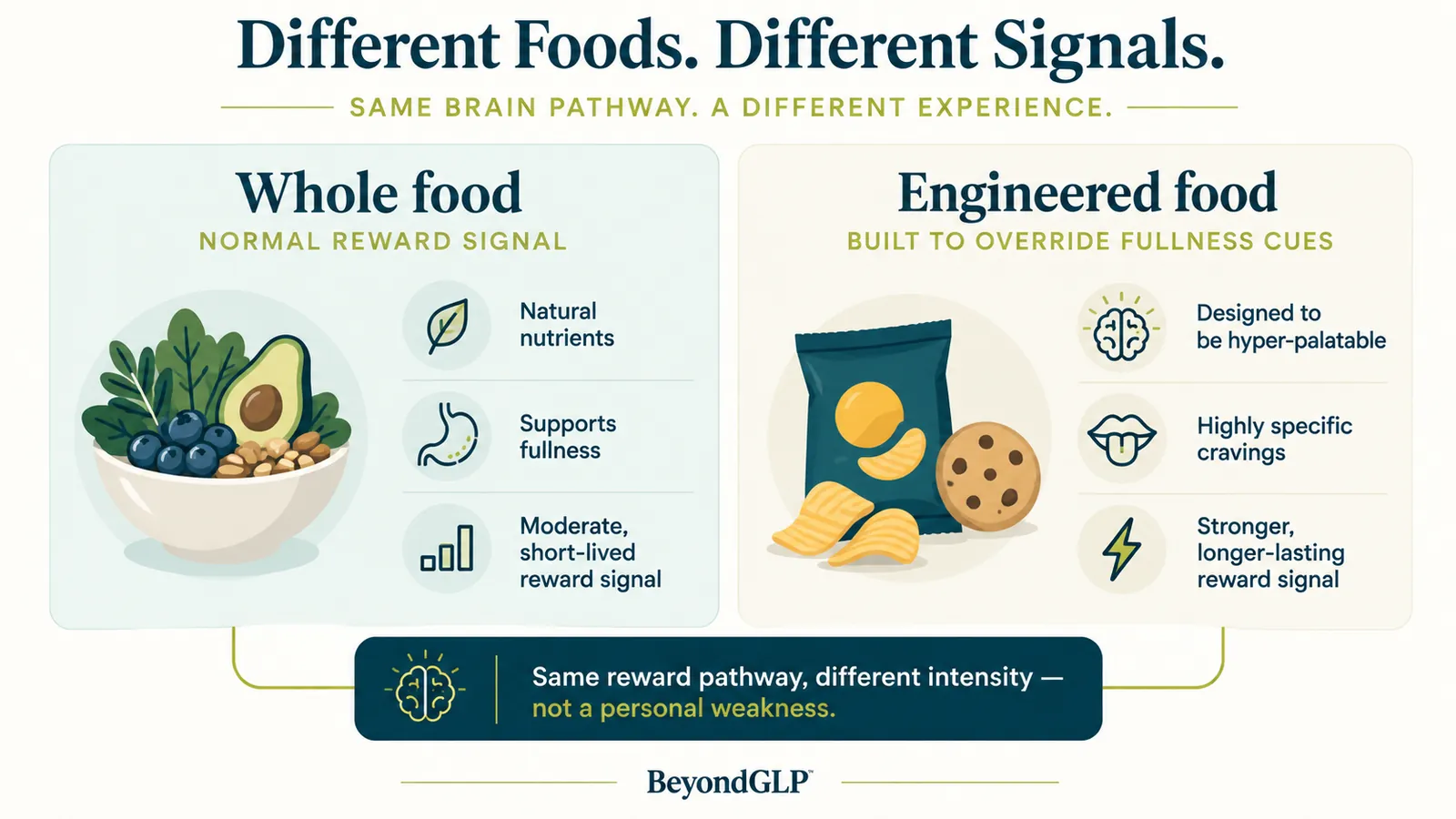
Animal research on intermittent, excessive sugar intake has documented changes in dopamine and opioid signalling that mirror other addictive substances — bingeing, withdrawal-like behaviour, and escalating tolerance (1). On the human side, a formal scientific review concluded that highly processed foods meet established clinical criteria for addictive substances, distinct from sugar in isolation (2). Foods engineered with specific combinations of sugar, fat, and salt are built to trigger the reward response more strongly than whole foods do — a food-engineering explanation, not a personal one.
What Changes With an Appetite Medication
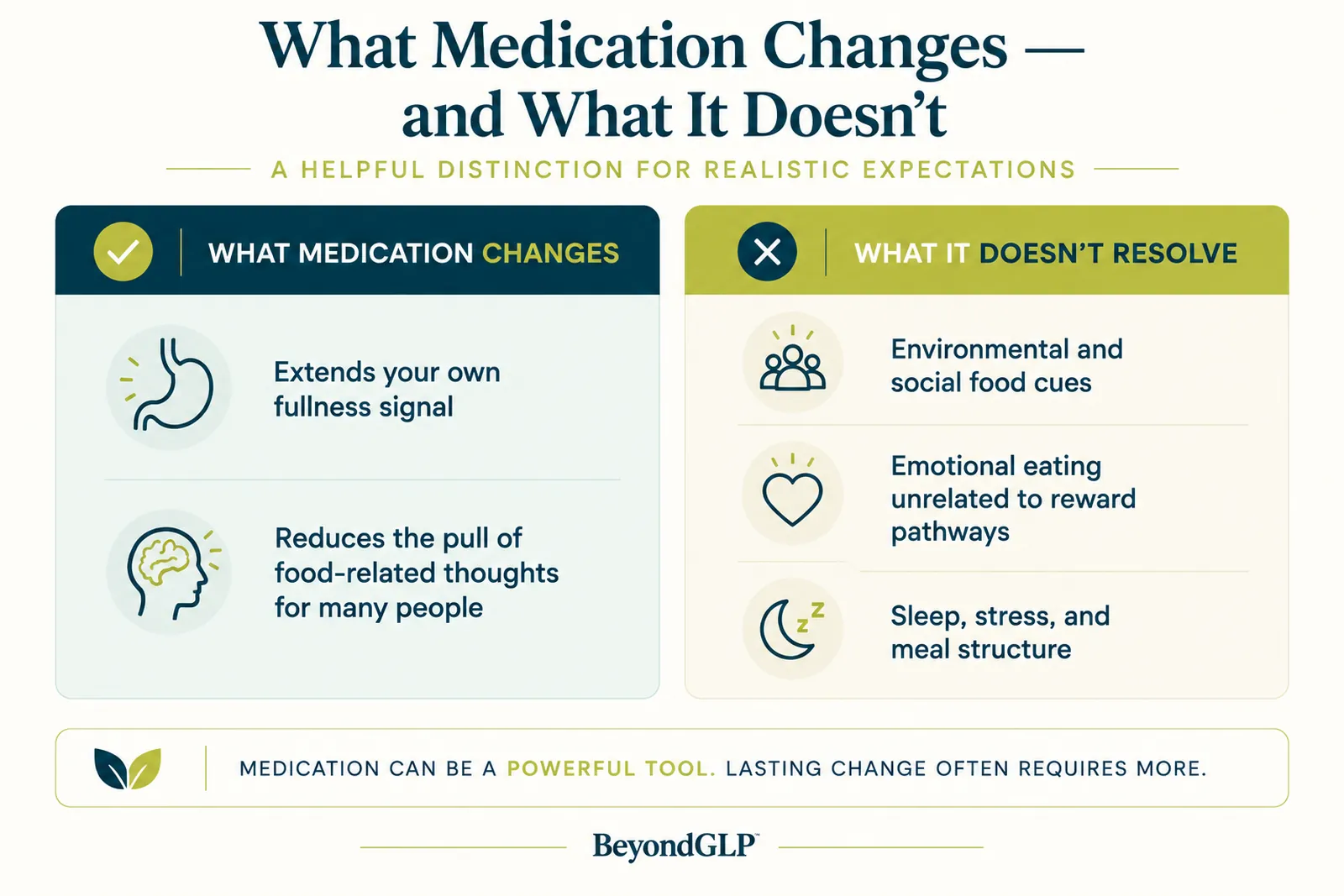
GLP-1 medications extend a signal your gut already produces on its own; the medication doesn't introduce a new mechanism so much as keep the existing one active for longer. A two-year follow-up within the STEP trial program found participants reported sustained improvements in their sense of control around eating over that period (3) — evidence that the effect on cravings isn't just an early adjustment period, but something that holds up over time for many people while the medication is active.
What Medication Does NOT Resolve
Medication doesn't erase environmental or social food cues, and it doesn't resolve emotional eating patterns that aren't rooted in the reward-pathway mechanism described above — those often still need their own attention. It also doesn't replace sleep, stress management, or meal structure; a medication plus those fundamentals is a meaningfully different picture than medication alone (see our full comparison of medication, natural support, and combined approaches). And the effect isn't guaranteed to be permanent: in a STEP trial extension, participants regained an average of two-thirds of their lost weight within a year of stopping semaglutide, alongside a reversal of the associated cardiometabolic improvements (4) — a signal that the appetite-regulating effect fades along with the drug, not something that becomes permanent rewiring for everyone.
When to Talk to a Clinician
If cravings or a sense of loss of control around food feel dependence-like and are affecting daily life, or if you're noticing intense cravings returning after stopping a GLP-1 medication, both are reasonable things to bring to a physician rather than manage alone.
Common Questions
Is sugar addictive in the same way drugs are?
Not identically, but there's real overlap. Animal studies show comparable dopamine and opioid changes, and a human review found highly processed foods meet clinical criteria for addictive substances (1, 2) — though the comparison to drug addiction specifically is still debated in the research.
Do GLP-1 medications stop sugar cravings?
They reduce them for many people by extending the body's own fullness signal, and two-year follow-up data shows the effect on eating control holds up over time for many users (3) — but it's not a universal or guaranteed effect, and it doesn't address every driver of craving.
What is food noise?
"Food noise" is the term commonly used for persistent, intrusive thoughts about food that go beyond ordinary hunger — a reward-pathway and appetite-signalling phenomenon, not a willpower issue.
Do cravings come back after stopping?
For many people, yes, to some degree — data from a semaglutide discontinuation study found participants regained an average of two-thirds of lost weight within a year of stopping, consistent with the appetite-regulating effect fading with the medication (4).
Scientific References
- 1.Avena NM, Rada P, Hoebel BG. Evidence for sugar addiction: behavioral and neurochemical effects of intermittent, excessive sugar intake. Neurosci Biobehav Rev, 2008. PMID: 17617461.
- 2.Gearhardt AN, DiFeliceantonio AG. Highly processed foods can be considered addictive substances. Addiction, 2023. PMID: 36349900.
- 3.Wharton S, et al. Two-year effect of semaglutide 2.4 mg on control of eating (STEP 5). Obesity, 2023. PMID: 36655300.
- 4.Wilding JPH, et al. Weight regain and cardiometabolic effects after withdrawal of semaglutide (STEP 1 extension). Diabetes Obes Metab, 2022. PMID: 35441470.
Educational only; not medical advice. This page discusses general research on food-related reward pathways and appetite medication; it does not diagnose dependence or any condition, and does not recommend starting, changing, or stopping any medication. GLP-1 medications should only be started, changed, or stopped under the supervision of your physician. Reviewed by Dr. Steven Gabriel, MD, September 2026.
Physician-built · Free · 3 min