Food Noise: Why Your Brain Won't Stop Asking for Food
It isn't in your head — it's in your biology.
Written by BeyondGLP Editorial Team · Medically reviewed by Dr. Gabriel, MD
See where your own signals stand → take the 2-minute assessment
Key Takeaways
- Food noise — the constant mental background chatter about eating — is a measurable signaling pattern, not a personality trait or a lack of discipline.
- It's driven by three overlapping systems: gut-brain satiety signaling, blood sugar stability, and the reward response triggered by heavily engineered foods.
- Ultra-processed foods are built to outpace your body's own “I'm full” signal, which is one reason food noise feels louder on some diets than others.
- Quieting food noise starts with understanding which of these systems is misfiring for you — not with trying harder.

From Dr. Gabriel
In the emergency department, I never once had a patient who came in because they lacked willpower. I've had plenty who came in exhausted from fighting their own appetite all day, every day, for years. That distinction matters. When a patient tells me they can't stop thinking about food, I don't hear a discipline problem — I hear a signaling problem, and signaling problems are things we can actually investigate.
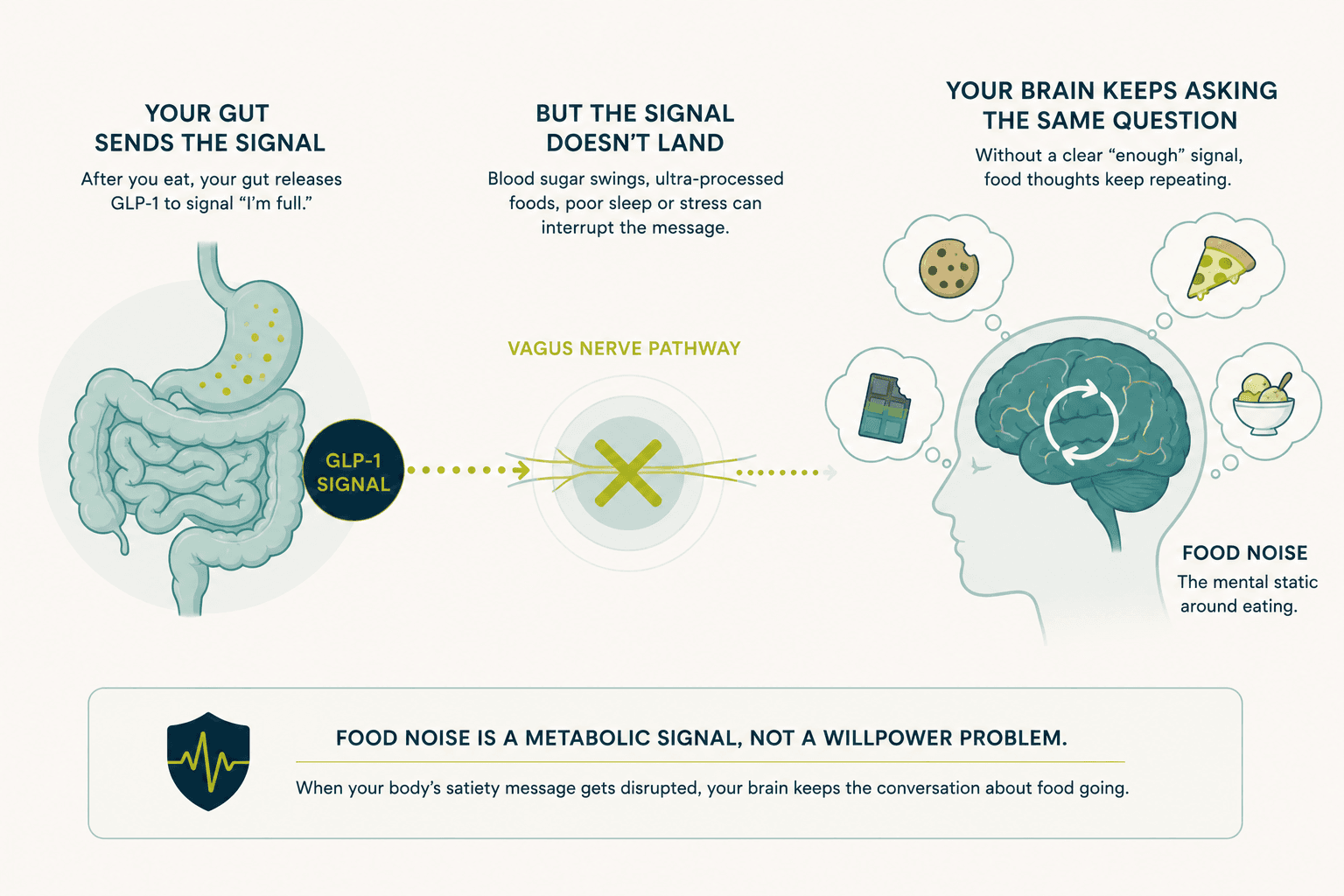
Maybe it starts an hour after breakfast. You're at your desk, you just ate, and somehow you're already running through what's in the pantry. Maybe it's worse at night — you're not hungry, not really, but some quiet, insistent voice keeps circling back to food. You've tried ignoring it. You've tried “just having discipline.” Neither works for long, and it leaves you wondering if something is wrong with you.
Food noise is the term for this — persistent, intrusive thoughts about food that show up whether or not you're actually hungry. It's not a character flaw, and it's not something most people can think their way out of. It's a signal, generated by real biological systems, and like any signal it has a source. This article walks through what's actually driving it. If you're also dealing with a general pull toward specific foods, it may help to read how cravings differ from food noise first.
What this means in plain English
Food noise is what it feels like when your appetite-regulation system is sending signals more often, or more loudly, than your actual energy needs require. Your body is built to tell you when to eat — through hunger — and when to stop — through satiety. Food noise shows up when that second signal, satiety, isn't landing the way it should, so your brain keeps circling back to a question it should have already answered.
Why this happens biologically
Appetite isn't run by willpower — it's run by a conversation between your gut and your brain. When you eat, cells in your intestine release a hormone called GLP-1, which travels partly through the vagus nerve and partly through the bloodstream to reach your brainstem and hypothalamus, telling your brain that food has arrived and that it's safe to stop eating (Drucker, Cell Metabolism, 2018; Brierley & de Lartigue, British Journal of Pharmacology, 2022). When this signaling is working well, that message lands clearly and the mental chatter about food goes quiet.
Blood sugar plays a supporting role. In a large study that tracked more than a thousand people through thousands of standardized and real-world meals, researchers found that a dip in blood sugar 2–3 hours after eating — not the size of the meal itself — was the strongest predictor of feeling hungry again and eating more over the following day (Wyatt et al., Nature Metabolism, 2021). In other words, you can eat a full meal and still get a strong hunger signal a couple of hours later if your blood sugar swings low, and that signal can register as food noise rather than straightforward hunger.
Food engineering adds a third layer. In a tightly controlled inpatient study at the NIH, researchers gave the same group of adults two diets — one built from whole foods, one built from ultra-processed foods — matched for calories, sugar, fat, and fiber. People eating the ultra-processed diet consumed about 500 more calories a day than they did on the whole-food diet, despite nothing else being different (Hall et al., Cell Metabolism, 2019). A more recent randomized crossover study measured this directly: participants eating ultra-processed meals ate faster and consumed hundreds more calories per day than on a matched whole-food diet (Hamano et al., Diabetes, Obesity and Metabolism, 2024).
How it connects to the Metabolic Signaling System
Food noise rarely comes from just one broken signal — it's usually the downstream effect of two or three signals misfiring together. Blood sugar instability drives the glucose-dip hunger response. A diet heavy in engineered foods can blunt the gut-brain satiety signal and drive faster eating and higher intake. And when GLP-1 signaling itself is running low — from poor sleep, chronic stress, or the food environment — the “I'm full” message that should quiet food noise doesn't arrive as strongly. These systems interact, which is why food noise can feel like it's coming from nowhere: it's rarely one thing, and it's never a lack of willpower.
Understanding your own metabolic profile — including metabolic health more broadly — is the starting point for identifying which of these signals is driving your own experience. And if you're on a GLP-1 medication, that same satiety signal is the one it amplifies — see GLP-1 medication support for how to work with it.
What standard advice often misses
Most advice for constant food thoughts treats it as a mindset problem — “practice mindful eating,” “distract yourself,” “just say no.” That advice assumes the signal itself is the problem, when the signal is usually accurate information about a system that isn't calibrated the way it should be. Telling someone with a blood-sugar-driven hunger dip to “have more willpower” is a bit like telling someone with a ringing phone to stop hearing it — the ring isn't the issue, whatever's calling is. The more useful question isn't “how do I ignore this,” it's “which of these systems needs attention.”
How to know where you stand
Food noise looks different depending on which signal is driving it — someone with unstable blood sugar experiences it differently than someone whose diet is heavy in engineered foods, and differently again if their GLP-1 signaling is generally low from stress or poor sleep. Because these drivers overlap, the useful next step is usually figuring out which one is doing most of the work for you specifically, rather than guessing.
Common Questions
Is food noise the same thing as hunger?
No. Hunger is your body signaling an actual energy need. Food noise is persistent thinking about food that shows up whether or not you need to eat — it's the signal continuing to fire after the actual need has been met, or firing based on blood sugar swings and food engineering rather than energy need itself.
Does this mean I have no control over it?
Not at all — it means the lever you're pulling matters. Trying to override food noise through willpower alone fights the wrong battle. Addressing the underlying signal — blood sugar stability, the proportion of engineered foods in your diet, sleep and stress — tends to be far more effective than trying to out-discipline a biological signal.
Can food noise change over time?
Yes. Because it's driven by physiological signals rather than fixed personality traits, it responds to changes in those signals. People who stabilize blood sugar or reduce reliance on heavily engineered foods often notice the mental chatter around food quiet down, though the degree and speed of that change varies by individual and by which signal was driving it.
Related metabolic signals
Scientific References
- Drucker DJ. Mechanisms of Action and Therapeutic Application of Glucagon-like Peptide-1. Cell Metabolism, 2018.
- Brierley DI, de Lartigue G. Reappraising the role of the vagus nerve in GLP-1-mediated regulation of eating. British Journal of Pharmacology, 2022.
- Wyatt P, Berry SE, Finlayson G, et al. Postprandial glycaemic dips predict appetite and energy intake in healthy individuals. Nature Metabolism, 2021.
- Hall KD, Ayuketah A, Brychta R, et al. Ultra-Processed Diets Cause Excess Calorie Intake and Weight Gain: An Inpatient Randomized Controlled Trial of Ad Libitum Food Intake. Cell Metabolism, 2019.
- Hamano S, Sawada M, Aihara M, et al. Ultra-processed foods cause weight gain and increased energy intake associated with reduced chewing frequency: A randomized, open-label, crossover study. Diabetes, Obesity and Metabolism, 2024.
Understanding which of these signals is loudest for you is the first real step toward quieting it.
Take the free BeyondGLP Metabolic Assessment →Educational content only. Information explains physiology and is not intended as medical advice. Always consult a qualified healthcare provider regarding medical decisions.