Peptides, Explained: What They Actually Are (And Why GLP-1 Is One of Them)
Science, not a product.
Written by BeyondGLP Editorial Team · Medically reviewed by Dr. Gabriel, MD
Key Takeaways
- A peptide is simply a short chain of amino acids — the body's own signaling molecules, not a lab invention.
- GLP-1, the molecule behind today's metabolism headlines, is itself a peptide your gut makes minutes after you eat.
- Your body already speaks in peptides: they carry messages between organs — including the gut-to-brain “I'm full” signal.
- The “peptide for weight loss” people search for is, at its root, a peptide your own body already produces — this article explains the science, not a product.

From Dr. Gabriel
Long before I ever prescribed a GLP-1 medication, I studied peptides as a molecular biologist — they're one of the most elegant pieces of the body's own design. A peptide isn't exotic. It's a short string of amino acids acting as a messenger, and your body makes thousands of them constantly, most of which you'll never hear about. GLP-1 happens to be the one everyone's talking about right now, but it was doing its job quietly in your gut long before it had a marketing campaign.
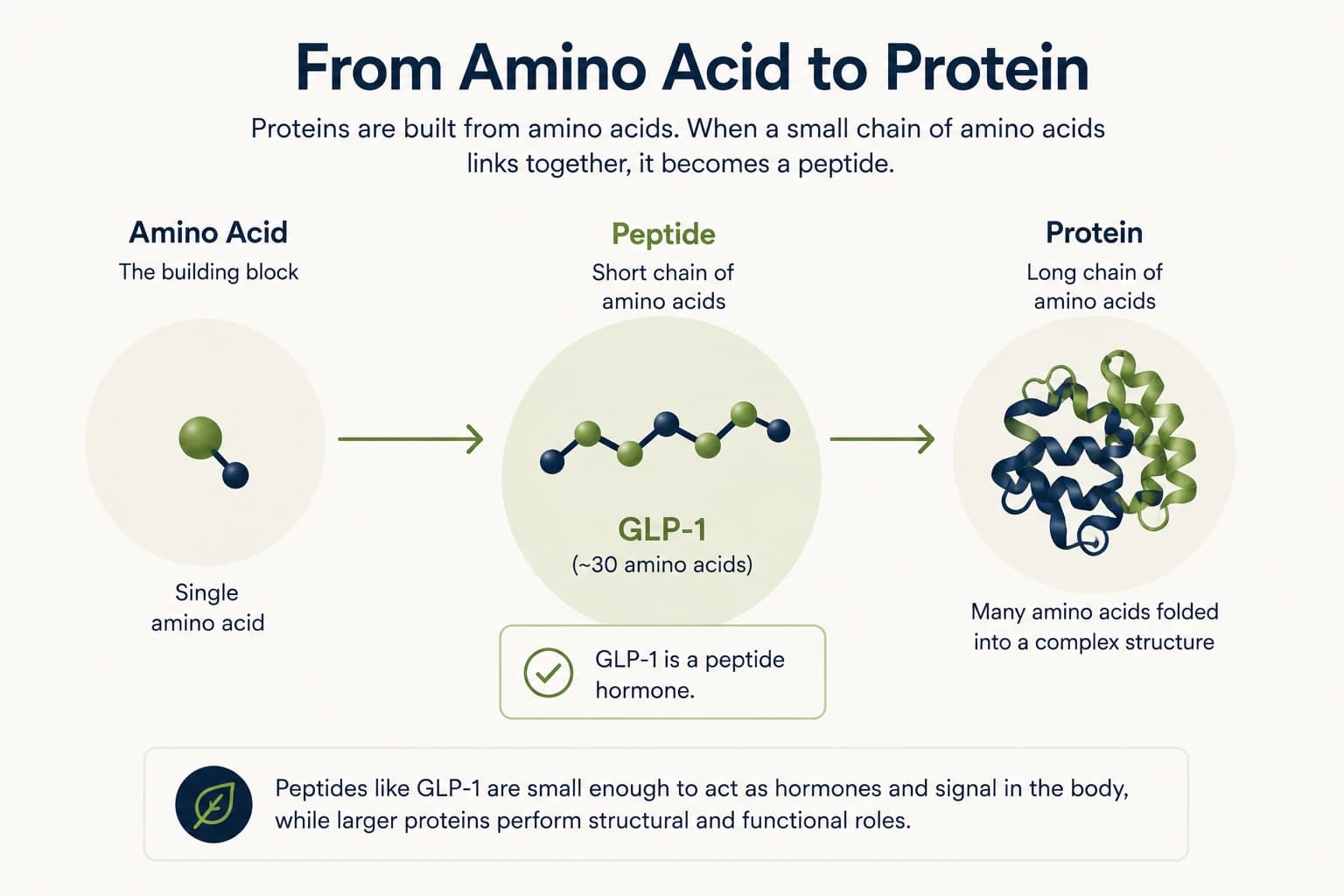
You've probably heard the word “peptide” a lot lately — in wellness marketing, in weight-loss headlines, often attached to something you're meant to buy. That framing makes peptides sound engineered, exotic, maybe a little suspicious. Here's the actual science: a peptide is just a short chain of amino acids, the same building blocks in every protein you eat. Your body makes thousands of them on its own, using them as messengers between organs. GLP-1, the molecule behind today's biggest metabolism headlines, is itself a peptide — released by your gut within minutes of eating, long before anyone turned it into a prescription. This article explains what peptides actually are, using GLP-1 as the example, before anyone tries to sell you a version of it.
What This Means in Plain English
Amino acids are the basic building blocks of protein. String a few of them together and you get a peptide; string together many more and you get a full protein. There's no hard cutoff, but generally, chains of roughly 50 amino acids or fewer are called peptides, and longer chains are proteins. GLP-1 sits clearly on the peptide side of that spectrum — it's a 30-amino-acid hormone, produced in specialized cells lining your intestine called L-cells.1
Peptides aren't manufactured substances or biohacks. They're one of the most ordinary things your body does, all day, every day, whether or not you're paying attention to it. Placing GLP-1 on this spectrum matters, because it reframes the whole conversation: the molecule behind the headlines isn't an invention. It's biology you already had.
Why This Happens Biologically
Peptides work as signals: one tissue releases them, another tissue receives the message, and something changes as a result. GLP-1 is a textbook example. Your intestinal L-cells release it within minutes of eating, and it travels to at least two destinations: the pancreas, where it helps trigger insulin release, and the brain, where it contributes to the feeling of fullness.1
Human studies going back to the late 1990s demonstrated this directly — infusing GLP-1 into healthy volunteers increased reported fullness and reduced how much food they ate at a later meal, with no medication involved at all.2 That's the peptide-as-messenger concept in its simplest, most direct form: a signal released after a meal, received by organs that need to know a meal happened, changing behavior and physiology in response. It's not a fat-burner. It's a messenger doing exactly what messengers do.
How It Connects to the Metabolic Signaling System
Peptides are one “vocabulary” within a much larger signaling network your body uses to coordinate metabolism. The conversation between your gut and your brain runs largely on peptide messengers, and GLP-1 belongs to a specific family called incretins, alongside a related hormone called GIP. Together, these two peptides coordinate how your body handles both appetite and blood sugar in the hours after you eat.3
Zooming out, this is the same broader system we describe on our page about how your metabolic signals work together — appetite, blood sugar, digestion, sleep, and stress responses are all, in different ways, conversations carried on by peptides and other signaling molecules. GLP-1 gets the headlines because a medication now amplifies it, but it was always one voice in a much larger conversation your body has been having with itself.
What Standard Advice Often Misses
Here's where the language gets genuinely confusing, and where the confusion can matter. The peptides your body makes on its own — endogenous signaling peptides like GLP-1 — are your own biology, functioning exactly as designed. Prescription GLP-1 receptor agonists are medications built to mimic and extend that signal. Unapproved, compounded, or research-grade “peptide” products marketed online are a third category entirely, and an important one to name clearly: they are outside the scope of this article, and evaluating, sourcing, or recommending them is not something we do here.
If you've encountered a peptide product online, the conversation about whether, or how, it fits into your health is one to have with a licensed physician, not a website. What we can tell you, with confidence, is that the search term “peptide for weight loss” is, at its root, describing a peptide your own body already produces. Understanding that signal — what it is, why it exists, what actually triggers it — is worth doing before anyone sells you a version of it.34
How to Know Where You Stand
If this article did its job, “peptide” should sound less exotic than it did five minutes ago. The next useful step is understanding your own signals — how your appetite, digestion, and fullness actually work, rather than shopping for a product that claims to replicate them. The free BeyondGLP Metabolic Assessment looks at exactly that. And if you want to go deeper on the medical side of GLP-1 specifically, including medications and what they do differently from your own biology, our GLP-1 pillar page is the place to start; our appetite regulation guide picks up where this one leaves off.
Common Questions
What are peptides, in simple terms?
A peptide is a short chain of amino acids that acts as a signaling molecule in the body. Your body makes thousands of them; they're not a lab invention or a supplement category.
Is GLP-1 a peptide?
Yes. GLP-1 is a 30-amino-acid peptide hormone produced by specialized cells in your intestine, released within minutes of eating.
What's the difference between a peptide and a protein?
Mostly length: peptides are shorter chains of amino acids, proteins are longer ones. There's no sharp cutoff, but the underlying building blocks — amino acids — are identical.
Are the peptides my body makes the same as peptide products sold online?
No. The peptides your body produces on its own, like GLP-1, are your own biology. Prescription GLP-1 medications are a separate, regulated category. Unapproved or research-grade peptide products sold online are a third category entirely, outside this article's scope, and a conversation for a licensed physician — not something we evaluate, source, or recommend here.
How does a peptide like GLP-1 make me feel full?
It travels from your gut to your brain and contributes to the sense of fullness after a meal. Human studies infusing GLP-1 into healthy volunteers showed increased fullness and reduced food intake at a later meal, entirely apart from any medication.
Scientific References
- Holst JJ. The physiology of glucagon-like peptide 1. Physiol Rev. 2007;87(4):1409–1439.
- Flint A, Raben A, Astrup A, Holst JJ. Glucagon-like peptide 1 promotes satiety and suppresses energy intake in humans. J Clin Invest. 1998;101(3):515–520.
- Nauck MA, Meier JJ. Incretin hormones: their role in health and disease. Diabetes Obes Metab. 2018;20(Suppl 1):5–21.
- Drucker DJ. Mechanisms of Action and Therapeutic Application of Glucagon-like Peptide-1. Cell Metab. 2018;27(4):740–756.
Take the free BeyondGLP Metabolic Assessment
Take the free BeyondGLP Metabolic Assessment →Understand your own signals before shopping for a product that claims to replicate them.
Educational content only. Information explains physiology and is not intended as medical advice. Always consult a qualified healthcare provider regarding medical decisions.