PCOS and Weight: Why It's Harder — and What Actually Works
It's a metabolic shift, not a willpower gap.
Written by BeyondGLP Editorial Team · Medically reviewed by Dr. Gabriel, MD
Key Takeaways
- Losing weight with PCOS is genuinely harder — it's a metabolic shift, not a willpower gap.
- Insulin resistance is the common driver behind PCOS symptoms, including how the body handles weight.
- Lifestyle changes — nutrition, activity, sleep — are the first-line approach in international clinical guidelines.
- PCOS affects roughly 1 in 8 women, and for most, insulin — not willpower — is the hidden driver.

From Dr. Gabriel
The piece most women with PCOS are never told plainly is that insulin, not discipline, is running the show. I've had patients who have tried every diet in circulation, blaming themselves the whole way through, when the actual lever they needed wasn't available to them yet because no one had explained the insulin connection. That's not a small omission. Once a woman understands that her body is working against an insulin-resistant backdrop, the whole approach changes — from punishing restriction to something more targeted and, frankly, kinder.

You're doing everything you think you're supposed to — tracking food, moving more, cutting back — and the weight won't move, or your cycle is unpredictable in a way it never used to be. If you have PCOS, this is real, it's common, and it is not a sign that you're doing something wrong. PCOS affects as many as 1 in 8 women, and for most, the hidden driver behind the weight struggle is insulin, not willpower.4PCOS is a hormonal and metabolic condition — not simply “cysts on the ovaries,” despite the name — and insulin resistance sits at the center of why weight behaves differently for women who have it.
What This Means in Plain English
PCOS, polycystic ovary syndrome, is diagnosed using a combination of irregular or absent ovulation, signs of elevated androgens (either in bloodwork or physical signs like acne or excess hair growth), and sometimes a particular ovarian appearance on ultrasound — a woman doesn't need all three to be diagnosed. The 2023 international evidence-based guideline, developed across six continents and used in 196 countries, notes the condition affects roughly 1 in 8 women of reproductive age.4It's best understood as a hormonal and metabolic condition with reproductive effects, not the other way around.
PCOS is not just a reproductive diagnosis. It's a metabolic condition that happens to show up first in the reproductive system.
Why This Happens Biologically
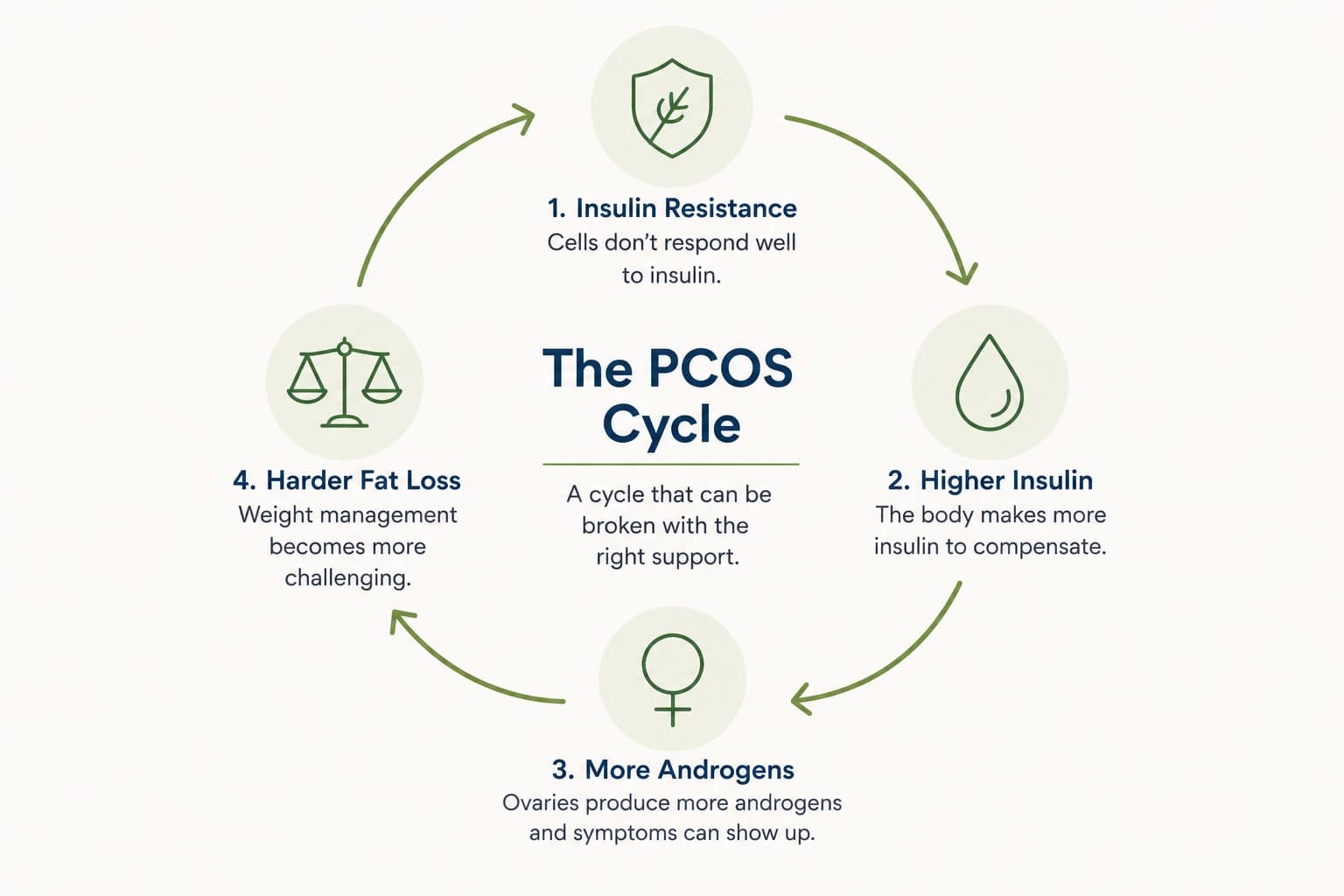
Insulin resistance is recognized as a central feature of PCOS, and it's largely independent of body weight — lean women with PCOS can be insulin resistant too, though the pattern is more consistent in women who are also carrying excess weight.2 Here's the mechanism: when cells resist insulin's signal, the pancreas compensates by producing more of it. That excess insulin does something specific in PCOS — it stimulates the ovaries to produce more androgens (male-pattern hormones like testosterone), and elevated androgens in turn make it harder to lose fat and easier to gain it, particularly around the midsection. That creates a cycle: more insulin resistance feeds more androgen production, which feeds more difficulty with weight, which can worsen insulin resistance further.
How It Connects to the Metabolic Signaling System
Because of this insulin-androgen cycle, PCOS carries a heightened risk of broader metabolic complications — a 2025 review examining weight management strategies in women with PCOS specifically notes that the condition is associated with a heightened risk of metabolic morbidity, worsened by insulin resistance and excess weight.1This is precisely why a generic “eat less, move more” approach tends to underperform for PCOS — it doesn't address the insulin resistance sitting underneath the weight struggle, so the same calorie deficit that works for someone without PCOS often produces a smaller result for someone with it.
The same effort produces a different result here because the underlying biology is different — that's a reason to adjust the approach, not a reason to blame the effort.
What Standard Advice Often Misses
International guidelines are explicit that lifestyle management — nutrition, physical activity, sleep, and, where relevant, modest weight change — is the first-line approach for PCOS, and that no single diet composition outperforms others; what matters more is an insulin-aware approach and consistency.3 In practice, that tends to mean steadier blood sugar through the day (regular meals, protein and fiber alongside carbohydrates) rather than an aggressive restriction that spikes stress hormones and can make insulin resistance worse. Medications like metformin or inositol are sometimes part of a treatment plan, but that decision — including whether either is appropriate, and at what dose — belongs to a conversation with your physician, not to this article.
How to Know Where You Stand
If you suspect insulin resistance is playing a role in your PCOS symptoms, the free BeyondGLP Metabolic Assessment looks at Energy & Blood Sugar Control alongside the rest of your metabolic picture, to help you see where the insulin connection might be showing up for you specifically.
A new PCOS diagnosis, fertility questions, or a recent change in symptoms are all good reasons to bring this to your own doctor or a specialist — this article is meant to inform that conversation, not replace it.
Common Questions
Why is it so hard to lose weight with PCOS?
Insulin resistance, which is common in PCOS and largely independent of body weight, drives up insulin levels, which in turn stimulate the ovaries to produce more androgens — and elevated androgens make fat loss harder and fat gain easier, particularly around the midsection. A 2025 review also notes PCOS carries a heightened risk of broader metabolic morbidity, which compounds the difficulty.
What's the best way to lose weight with PCOS?
International guidelines point to lifestyle management — consistent nutrition, activity, and sleep, with an insulin-aware approach — as the first-line strategy, and note that no single diet composition works better than others across the board. Consistency with an approach that stabilizes blood sugar tends to matter more than the specific diet chosen.
Does insulin resistance cause PCOS weight gain?
It's a central driver. Insulin resistance raises insulin levels, which push the ovaries to produce more androgens, and higher androgens make it harder to lose fat and easier to gain it — creating a cycle that compounds over time if left unaddressed.
Can PCOS be cured?
No — PCOS is managed, not cured. But it's very manageable: lifestyle changes, and sometimes medical treatment guided by your physician, meaningfully improve symptoms, cycle regularity, and metabolic markers for most women.
Related metabolic signals
Scientific References
- Diakosavvas M, Oyebode O, Bhide P. Weight Management Strategies to Reduce Metabolic Morbidity in Women With PCOS. Curr Obes Rep. 2025;14:22.
- Diamanti-Kandarakis E, Dunaif A. Insulin resistance and the polycystic ovary syndrome revisited. Endocr Rev. 2012;33(6):981–1030.
- International PCOS Network. Evidence summaries and recommendations from the international evidence-based guideline for PCOS: Lifestyle management. Obes Rev. 2020;21(10):e13046.
- Teede HJ, et al. Recommendations From the 2023 International Evidence-based Guideline for the Assessment and Management of PCOS. J Clin Endocrinol Metab. 2023;108(10):2447–2469.
Physician-built · Free · 3 min
See what's actually driving your metabolism.
Educational content only. Information explains physiology and is not intended as medical advice. Always consult a qualified healthcare provider regarding medical decisions.