What GLP-1 Actually Does in Your Body (And Why It’s Not Just a "Weight-Loss Hormone")
It isn't a lab invention — it's a hormone your own gut already makes every time you eat.
Written by BeyondGLP Editorial Team · Medically reviewed by Dr. Gabriel, MD
Key Takeaways
- GLP-1 is a hormone your own gut makes after you eat — it isn't only a drug.
- It slows how fast your stomach empties, signals fullness to your brain, and helps regulate blood sugar.
- GLP-1 medications amplify a signal your body already produces — they don't create a new one.
- Food choices — protein, fiber, the bacteria in your gut — influence how much of your own GLP-1 you release.

From Dr. Gabriel
I see this confusion frequently with patients: people talk about GLP-1 like it's a drug that got invented in a lab, something foreign you're putting into your body. It isn't. Your gut has been making it every time you eat since before you ever heard the word semaglutide. What the medications do is take a signal that your body already sends and turn the volume up, and keep it turned up longer than your own biology would on its own. That distinction matters, because it changes how you think about the whole picture — the medication isn't replacing something broken, it's amplifying something that's already there.
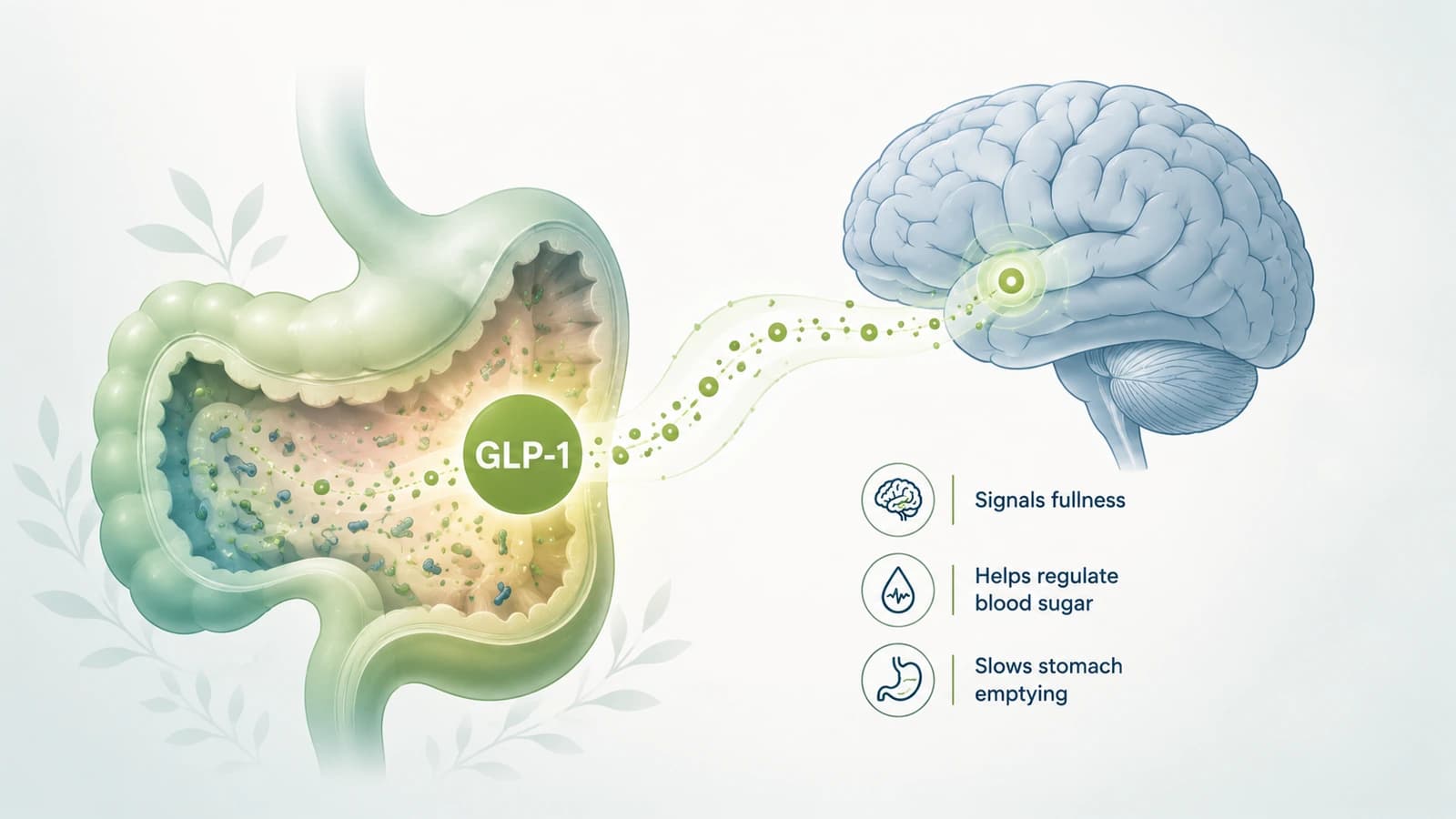
GLP-1 gets talked about like it's a lab invention — the “weight-loss hormone,” something that arrived with a brand name. It didn't. Your intestine has been releasing GLP-1 every time you eat for your entire life. Right now, only about 1 in 8 American adults meets the criteria for optimal metabolic health5 — and GLP-1 sits at the center of why that number is so low. GLP-1, short for glucagon-like peptide-1, is an incretin hormone released from cells lining your small intestine within minutes of eating.1It slows how quickly food leaves your stomach, tells your brain you're full, and helps your pancreas manage blood sugar. Understanding your own GLP-1 — whether or not you ever take a medication — changes how you think about hunger, fullness, and food noise.
What This Means in Plain English
GLP-1 belongs to a family of gut hormones called incretins. Specialized cells in your intestinal lining, called L-cells, release it in response to a meal — concentrations rise within minutes of eating and fall again as digestion finishes.1This is ordinary physiology, not a drug. Every person's body does this, in varying amounts, dozens of times a week. The medications built around GLP-1 (semaglutide, liraglutide, and others) are receptor agonists — they bind to the same receptor your own hormone binds to and activate it, but they resist the enzyme that normally breaks GLP-1 down within minutes, so the signal lasts hours instead of minutes.
Your body already runs this system. The question worth asking isn't “what does the drug do” — it's “what is my own GLP-1 doing, and how well?”
Why This Happens Biologically
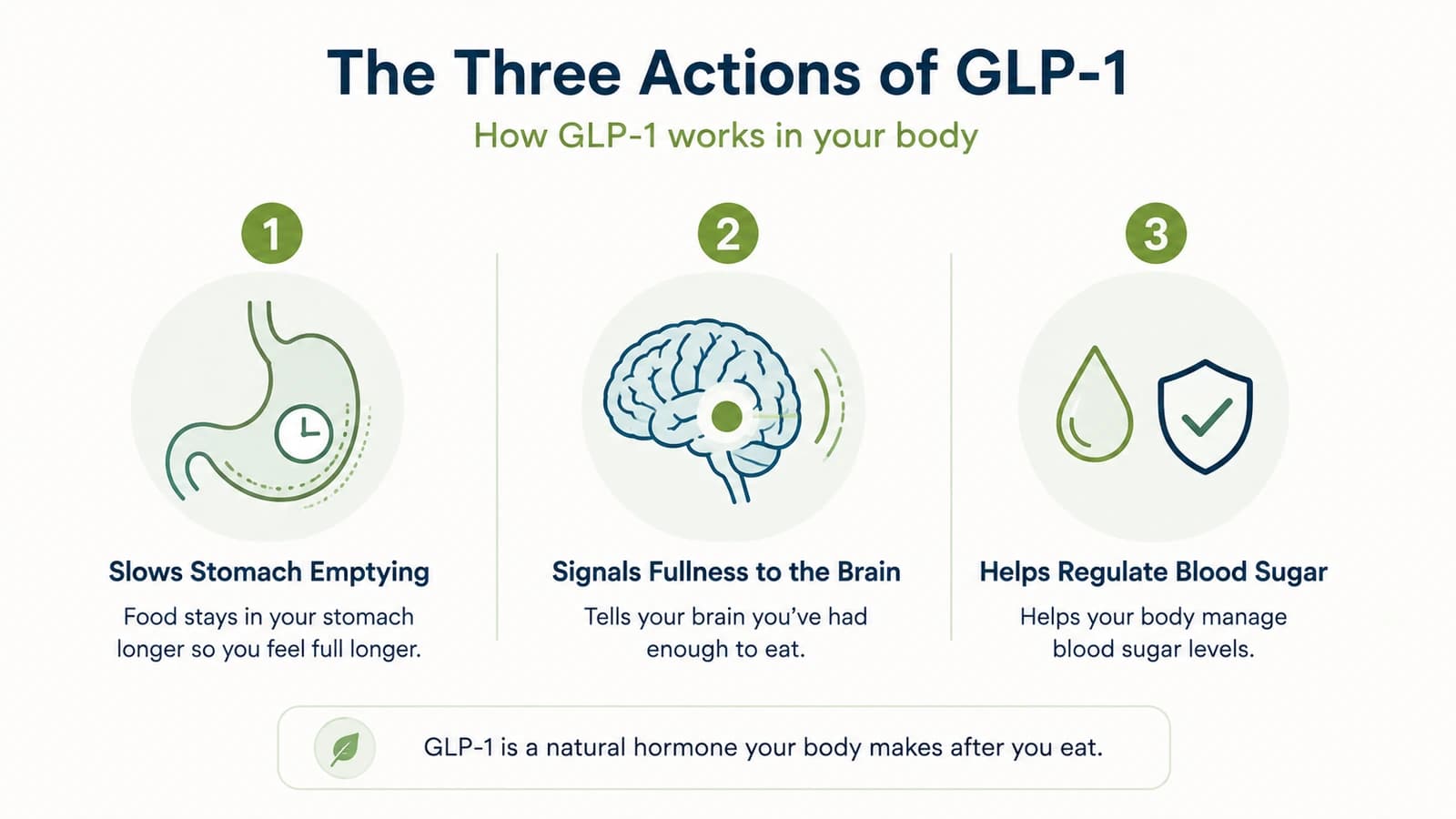
GLP-1 works through three coordinated actions. It slows gastric emptying, so food stays in your stomach longer and you feel full sooner and stay full longer.1It acts on satiety centers in the brain via the gut-brain axis, which is a large part of why adequate GLP-1 signaling quiets what people describe as “food noise” — the constant background hum of thinking about food.2And it prompts your pancreas to release insulin in a glucose-dependent way, meaning it helps smooth out blood sugar after a meal without pushing insulin out when you don't need it. GLP-1 is best understood as a regulator of appetite and glucose — not a fat-burning switch.
How It Connects to the Metabolic Signaling System
This is where medications enter the picture, and it's worth being precise about the mechanism. GLP-1 receptor agonist medications are engineered to resist the enzyme (DPP-4) that ordinarily clears your own GLP-1 within a couple of minutes, so the receptor stays activated for hours or, with some formulations, up to a week. The pivotal STEP 1 trial randomized 1,961 adults without diabetes to once-weekly semaglutide or placebo alongside lifestyle intervention, and participants on semaglutide lost an average of 14.9% of body weight over 68 weeks, with 86% losing at least 5%, compared to a much smaller effect in the placebo group.3That result belongs to the trial and the medication — it's a pharmacologic effect layered on top of your own biology, prescribed and monitored by a physician. It is not evidence that your own endogenous GLP-1 will produce the same numbers on its own.
The trial data describes what the medication does under medical supervision. It doesn't describe what your body does on its own — those are two different questions.
What Standard Advice Often Misses
Two things get left out of most conversations about GLP-1. First, for people on GLP-1 medications: a meaningful share of the weight lost isn't fat. A 2025 systematic review and meta-analysis of randomized trials found that lean mass accounted for roughly 25% of total weight loss on GLP-1 receptor agonists, even though the percentage of lean mass relative to total body weight didn't change much.6 That's a real reason to prioritize protein intake and resistance training during treatment, not a reason to avoid the medication — we cover the specifics on the muscle-loss child page.
Second, for anyone curious about their own GLP-1: short-chain fatty acids, produced when gut bacteria ferment fiber, stimulate GLP-1 release from intestinal L-cells through a receptor called FFAR2. This has been demonstrated in colonic tissue culture and in mouse models4 — the mechanism is well established at the cellular level, though direct human dietary trials measuring GLP-1 response to fiber intake are still limited. Fiber-rich, protein-forward meals are a reasonable, low-risk way to support your own signaling either way.
How to Know Where You Stand
Whether you're on a GLP-1 medication, considering one, or just want to understand your own appetite and blood sugar signals better, the starting point is the same: get a clear picture of where your metabolic system actually stands today. The free BeyondGLP Metabolic Assessment walks through the signals — appetite, energy, digestion, sleep, hormones — that GLP-1 touches, and gives you a personalized starting point.
If you're having side effects on a medication, thinking about stopping one, or have questions about muscle loss or long-term use, those deserve a conversation with your prescribing physician — this article is educational, not a substitute for that conversation.
Explore the GLP-1 series
- GLP-1 Side Effects — how side effects of GLP-1 medications relate to metabolism.
- Stopping GLP-1 — appetite and metabolism when a medication is discontinued.
- Muscle Loss on GLP-1 — protecting lean muscle mass during weight loss.
- Natural GLP-1 Support — how diet and lifestyle influence your body's own GLP-1 signaling.
- Medications vs. Natural — medications compared with approaches that support endogenous GLP-1.
- Peptides, Explained — what peptides actually are, and why GLP-1 is one of them.
- What to Eat on a GLP-1 — a doctor-led food guide for protein, fiber, and protecting muscle.
Common Questions
What does GLP-1 do in the body?
GLP-1 is released from your intestine after eating and does three main things: it slows gastric emptying so you feel full longer, it signals satiety to your brain, and it helps your pancreas regulate blood sugar in a glucose-dependent way.
Is GLP-1 the same as Ozempic or Wegovy?
No. GLP-1 is the hormone your body makes naturally. Ozempic and Wegovy contain semaglutide, a medication that activates the same receptor as your own GLP-1 but resists breakdown, so its effect lasts far longer than your endogenous hormone's minutes-long window. The STEP 1 trial is the pivotal study behind semaglutide's approval for weight management.
Can I raise my GLP-1 naturally?
Fiber fermented by gut bacteria produces short-chain fatty acids that stimulate GLP-1 release from intestinal cells in laboratory and animal research; whether this translates into a measurable, sustained increase in humans from diet alone is still being studied. Protein-forward, fiber-rich meals are a reasonable way to support the system you already have.
Does GLP-1 medication cause muscle loss?
A 2025 meta-analysis of GLP-1 receptor agonist trials found that lean mass made up roughly a quarter of total weight lost, so yes, some of the weight lost with these medications is muscle rather than fat. Adequate protein intake and resistance training are the evidence-supported ways to help protect lean mass during treatment — talk with your prescribing physician about your specific plan.
Related metabolic signals
Scientific References
- Drucker DJ. Mechanisms of Action and Therapeutic Application of Glucagon-like Peptide-1. Cell Metab. 2018;27(4):740–756.
- Nauck MA, Meier JJ. Incretin hormones: their role in health and disease. Diabetes Obes Metab. 2018;20(Suppl 1):5–21.
- Wilding JPH, et al. Once-Weekly Semaglutide in Adults with Overweight or Obesity (STEP 1). N Engl J Med. 2021;384(11):989–1002.
- Tolhurst G, et al. Short-Chain Fatty Acids Stimulate Glucagon-Like Peptide-1 Secretion via the G-Protein–Coupled Receptor FFAR2. Diabetes. 2012;61(2):364–371.
- Araújo J, Cai J, Stevens J. Prevalence of Optimal Metabolic Health in American Adults: NHANES 2009–2016. Metab Syndr Relat Disord. 2019;17(1):46–52.
- Karakasis P, Patoulias D, Fragakis N, Mantzoros CS. Effect of glucagon-like peptide-1 receptor agonists and co-agonists on body composition. Metabolism. 2025;164:156113.
Physician-built · Free · 2 min
See what's actually driving your metabolism.
BeyondGLP focuses on your body's own (endogenous) GLP-1 — the hormone your gut releases to regulate appetite — which is distinct from prescription GLP-1 medications. This content is educational and explains physiology; it is not medical advice and does not provide dosing or treatment guidance. Always consult a qualified healthcare provider about medications and medical decisions.
Educational content only. Information explains physiology and is not intended as medical advice. Always consult a qualified healthcare provider regarding medical decisions.