Are You Losing Muscle on a GLP-1? What the Evidence Says About Protecting Lean Mass
The scale doesn't tell you what actually came off.
Written by BeyondGLP Editorial Team · Medically reviewed by Dr. Gabriel, MD
Key Takeaways
- When you lose weight quickly, some of what comes off is muscle, not only fat — this is true of any rapid weight loss, not unique to GLP-1 medications.
- In a 2025 network meta-analysis of 22 randomized trials, roughly 25% of the total weight lost on GLP-1 therapy was lean mass.
- Adequate protein and resistance training are the two best-studied ways to support muscle while losing weight.
- Protein does double duty: it supports satiety and weight maintenance, and protein and calcium also prompt your own gut to release GLP-1 — a signal separate from any medication.
- Any change to a GLP-1 medication is a decision for you and your doctor — this page is education, not medical advice.

From Dr. Gabriel
The scale going down isn't the whole story. I've had patients who lost thirty pounds and felt weaker, not stronger, because some of what came off was muscle and nobody had told them that was even a possibility. That's not a reason to fear the medication. It's a reason to pay attention to two things doctors have known matter for decades: protein and resistance training. This is manageable. It just isn't automatic.
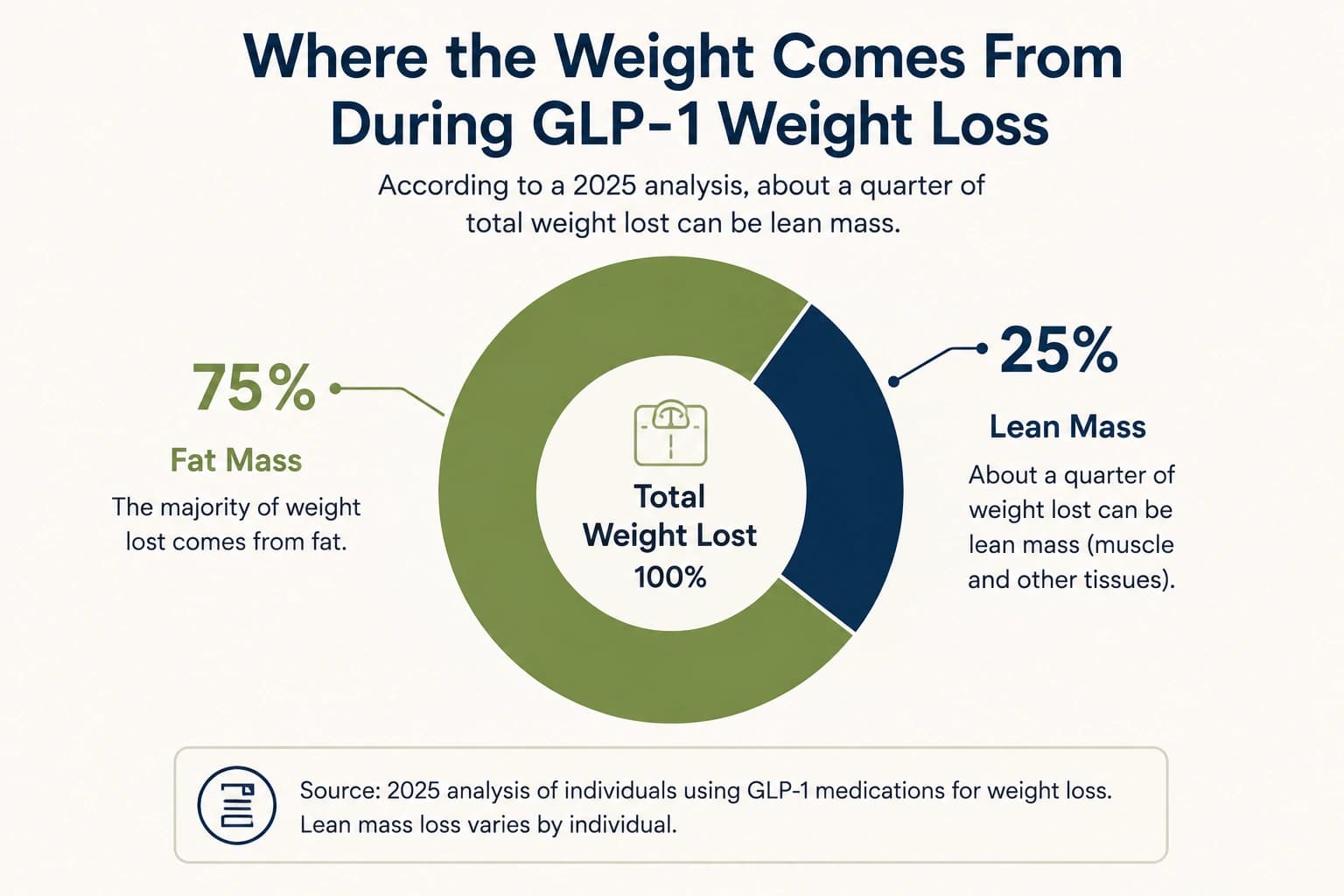
If you're a few months into a GLP-1 and the scale is finally moving the way you hoped, it's worth also knowing what's actually coming off. Some of it is fat, which is the point. Some of it, though, is muscle — and that's true of rapid weight loss generally, not something unique to these medications. A 2025 analysis of 22 randomized trials found that roughly a quarter of the total weight lost on GLP-1 therapy was lean mass. That number sounds alarming until you understand why it happens and what actually helps. Two things matter most: getting enough protein, and giving your muscles a reason to stick around through resistance training. Neither is a guarantee. Both are the best evidence we have.
What This Means in Plain English
Your body weight is made up of fat mass, lean mass (mostly muscle, plus organs and water), and everything else. When you lose weight quickly — through a large calorie deficit, whether from a GLP-1 medication, surgery, or aggressive dieting — your body draws energy from both fat stores and muscle tissue.
A 2025 network meta-analysis pooling 22 randomized controlled trials, involving more than 2,000 participants, found that GLP-1 receptor agonists produced significant reductions in total body weight, fat mass, and lean mass, with lean mass making up roughly 25% of the total weight lost.1That's not a sign that something has gone wrong with your medication. It's the same physiology that shows up with any large, fast weight loss — the GLP-1 just makes the weight loss itself faster and larger, which is why the muscle loss is more noticeable.
Why This Happens Biologically
In a large energy deficit, your body needs fuel from somewhere, and it draws on both fat and muscle tissue, not fat alone. Several factors make muscle loss worse: inadequate protein intake, older age (where the body is already more prone to losing muscle, a process called sarcopenia), and the absence of any strength stimulus telling your muscles they're still needed.
GLP-1's role in this picture is really about appetite: the hormone slows gastric emptying and increases fullness, which lowers how much you eat.2It isn't a “muscle-wasting” drug in any direct sense — the muscle loss tracks the rapid weight loss itself, the same way it would with any other method that produced weight loss this quickly. Understanding that distinction matters, because it changes where you focus your attention: not on the medication, but on the two levers that are actually within your control.
What the Evidence Says About Protecting Lean Mass
Two things are consistently associated with better lean mass preservation during weight loss: adequate dietary protein and resistance training. A 2015 review in the American Journal of Clinical Nutrition found that higher-protein diets were associated with greater preservation of lean mass during calorie-restricted weight loss compared with lower-protein diets, alongside benefits for satiety and weight maintenance.3Resistance training works differently: it gives your body an ongoing reason to keep the muscle you have, even while you're eating less overall.
You'll sometimes see specific numbers thrown around — something like 1.2 to 1.6 grams of protein per kilogram of body weight, or resistance training two to three times a week. Those figures circulate widely as general, commonly-cited guidance, but they aren't drawn from a single citable study in this article, so we're presenting them as exactly that: common guidance, not a prescription. For a more detailed breakdown of how much protein you actually need, see our companion guide. None of this involves adjusting your GLP-1 medication.
The GLP-1 Connection People Miss
Here's a detail that rarely makes it into muscle-loss conversations: protein and calcium in food prompt your own intestinal cells to release GLP-1 — a completely separate process from a prescribed GLP-1 receptor agonist.4 This is your own biology responding to what you eat, not a medication.
Eating enough protein does two jobs at once: it supports muscle maintenance directly, and it also supports your body's own satiety signaling, working through the exact same hormone pathway a GLP-1 medication targets pharmacologically. That doesn't mean eating more protein is a substitute for your medication, or a reason to change how you take it — those two things operate on completely different scales and aren't interchangeable. But it's a good example of how much your everyday food choices are already talking to the same system your prescription is working on.
How to Know Where You Stand
The number on the scale doesn't tell you what came off. Body composition — the ratio of fat to lean mass — is what actually matters, and that requires a measurement your doctor can help you interpret, not a guess based on how your clothes fit.
If you're concerned about muscle loss on a GLP-1, or considering any change to your medication, that's a conversation for you and your physician, not something to decide alone. If you want to understand your own metabolic signals more broadly, the free BeyondGLP Metabolic Assessment is a good starting point, and our guides on GLP-1 side effects and how much protein you actually need go further into the pieces this page only introduces.
Common Questions
Does Ozempic / GLP-1 cause muscle loss?
Weight loss on a GLP-1 includes some lean tissue, the same as it would with any fast, large weight loss. A 2025 meta-analysis found lean mass made up roughly a quarter of total weight lost across 22 randomized trials.
How much of the weight I lose on a GLP-1 is muscle?
In the largest pooled analysis to date, roughly 25% of total weight lost was lean mass, though this varies by individual, by which GLP-1 medication is used, and by dose.
How do I protect muscle while losing weight on a GLP-1?
The two best-studied levers are adequate protein intake and resistance training. Both are associated with better lean mass preservation during calorie-restricted weight loss.
Can eating protein affect my own GLP-1?
Yes — protein and calcium prompt your intestinal cells to release your own GLP-1, a natural process separate from any medication.
Related metabolic signals
Scientific References
- Karakasis P, Patoulias D, Fragakis N, Mantzoros CS. Effect of glucagon-like peptide-1 receptor agonists and co-agonists on body composition: systematic review and network meta-analysis. Metabolism. 2025;164:156113.
- Drucker DJ. Mechanisms of Action and Therapeutic Application of Glucagon-like Peptide-1. Cell Metab. 2018;27(4):740–756.
- Leidy HJ, Clifton PM, Astrup A, et al. The role of protein in weight loss and maintenance. Am J Clin Nutr. 2015;101(6):1320S–1329S.
- Watkins JD, Koumanov F, Gonzalez JT. Protein- and Calcium-Mediated GLP-1 Secretion: A Narrative Review. Adv Nutr. 2021;12(6):2540–2552.
Understand what's actually changing in your body composition — not just the number on the scale.
Take the free BeyondGLP Metabolic Assessment →BeyondGLP focuses on your body's own (endogenous) GLP-1 — the hormone your gut releases to regulate appetite — which is distinct from prescription GLP-1 medications. This content is educational and explains physiology; it is not medical advice and does not provide dosing or treatment guidance. Always consult a qualified healthcare provider about medications and medical decisions.
Educational content only. Information explains physiology and is not intended as medical advice. Always consult a qualified healthcare provider regarding medical decisions.