GLP-1 Side Effects: Why They Happen and When to Talk to Your Doctor
The most common side effects are the mechanism working, not malfunctioning.
Written by BeyondGLP Editorial Team · Medically reviewed by Dr. Gabriel, MD
Key Takeaways
- Most GLP-1 medication side effects are digestive — nausea, fullness, changes in bowel habits — because the drug amplifies the same signal your gut already uses to slow the stomach and cue satiety.
- These medications don't create a new process; they extend a signal you naturally produce, which is also why the effects are usually predictable.
- The trade-off is real: GLP-1 therapy can drive substantial weight loss, but a meaningful share of tissue lost can be lean mass, which is its own reason to stay in touch with your doctor.
- Some symptoms are common and expected; others are signals to contact your physician. Knowing the difference is the point — none of this is self-management advice.

From Dr. Gabriel
In the ER, I've had patients convinced something had gone wrong because a GLP-1 made them nauseated after a big meal. Once I explain what's actually happening physiologically, most of them felt reassured. Your gut has been doing this dance long before anyone put it in a pen; the medication just turns the volume up. That doesn't mean every symptom is fine to ride out — some things genuinely need a call to your doctor. But understanding the mechanism is usually the first thing that calms a scared patient down.
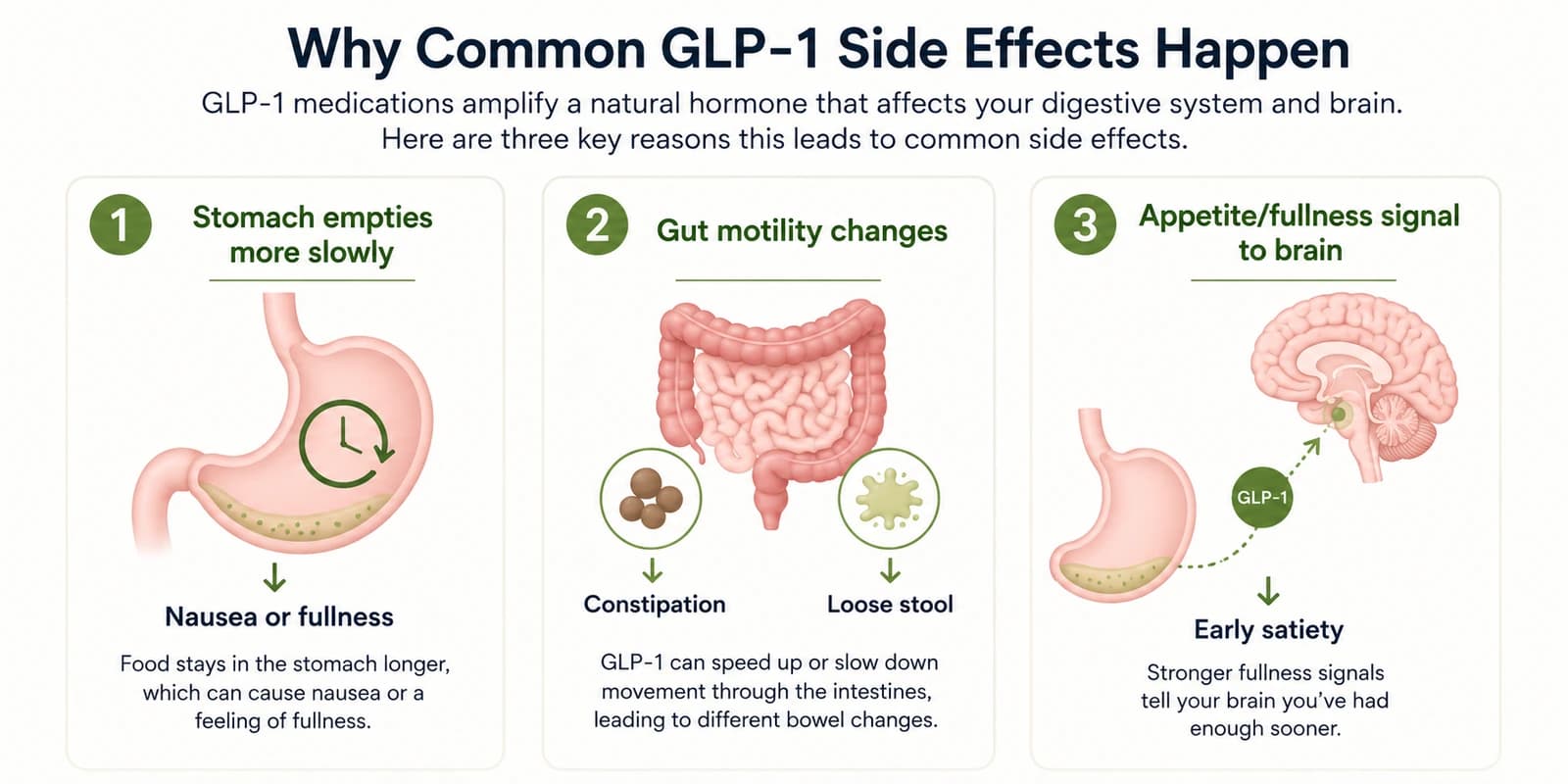
If you started a GLP-1 medication, or you're considering one, you've probably read a side-effect list that sounds alarming: nausea, bloating, constipation, reflux. It's reasonable to wonder if something is wrong. Here's the reassuring part: the most common GLP-1 side effects are a direct, predictable echo of how the hormone works in the first place — it slows your stomach down and tells your brain you're full. A medication that extends that same signal will also extend its digestive footprint. That's not a malfunction. It's the mechanism doing exactly what it's designed to do, just for longer than your body would do it on its own. This page explains why that happens, and when a symptom is worth a call to your doctor rather than something to wait out.
What This Means in Plain English
GLP-1 stands for glucagon-like peptide-1, a hormone your gut makes on its own, every time you eat. It's released by cells lining your intestine within minutes of a meal, and its job is to slow down how quickly your stomach empties, help your pancreas release insulin, and signal to your brain that you've had enough.1 A GLP-1 medication — semaglutide, liraglutide, tirzepatide, and others — activates the same receptor that your own GLP-1 activates, only the medication resists being broken down as quickly, so the signal lasts much longer.
A “side effect,” in that light, isn't a malfunction. It's what you'd expect when a natural braking system stays engaged longer than it normally would. The hormone your body makes and the medication your doctor prescribes point at the same target, but they are not interchangeable, and we keep that distinction clear throughout this page.
Why This Happens Biologically
Three mechanisms account for most of what people notice. First, slowed gastric emptying: food sits in your stomach longer, which is why nausea, early fullness, and reflux are so common, particularly in the first weeks or after a dose increase. Second, altered gut motility further down the digestive tract, which can show up as constipation for some people and looser stools for others — the same underlying signal, expressed differently depending on the individual.
Third, the hormone doesn't act only locally. It reaches appetite and reward circuits in the brain, and functional imaging research has shown reduced activity in reward-related brain regions in response to food cues when GLP-1 receptors are activated.2That's the biological basis for reduced appetite and, for some people, a noticeable drop in interest in foods they used to crave. None of this is the medication attacking anything — it's a regulatory system that normally runs quietly, now running louder.
How It Connects to the Metabolic Signaling System
Here's the piece that's easy to miss: your own GLP-1 is broken down by an enzyme called DPP-4 within minutes of release, which is why the natural signal is short-lived. GLP-1 medications are built to resist that breakdown, so a single dose keeps the receptor activated for days rather than minutes. That extended activation is exactly what makes these medications effective, and it's also what extends the digestive footprint described above — the efficacy and the side-effect profile come from the same mechanism, not two separate ones.
In the STEP 1 trial, semaglutide 2.4 mg produced roughly 15% mean weight loss over 68 weeks compared with placebo, alongside a lifestyle intervention.3That's a meaningful result, and side effects were part of the trade patients and their physicians weighed to get there. This is prescribed, monitored medicine — nothing here is a cue to adjust your own dose or timing.
What Standard Advice Often Misses
Most side-effect lists stop at the digestive symptoms people expect. Two things get less attention. First, a share of the weight lost on GLP-1 therapy isn't fat — a 2025 meta-analysis of 22 randomized trials found that roughly a quarter of total weight lost was lean tissue, not fat mass.4That's a quieter consequence worth discussing with your doctor, and we cover it in more depth in our piece on protecting muscle on GLP-1.
Second, digestive side effects are one of the most common reasons people consider stopping their medication altogether. That's a legitimate conversation to have — but it's a conversation for you and your physician, not a decision to make alone based on how you feel during a rough week. We walk through what actually happens when someone stops a GLP-1 in a separate article, because that physiology deserves its own explanation.
How to Know Where You Stand
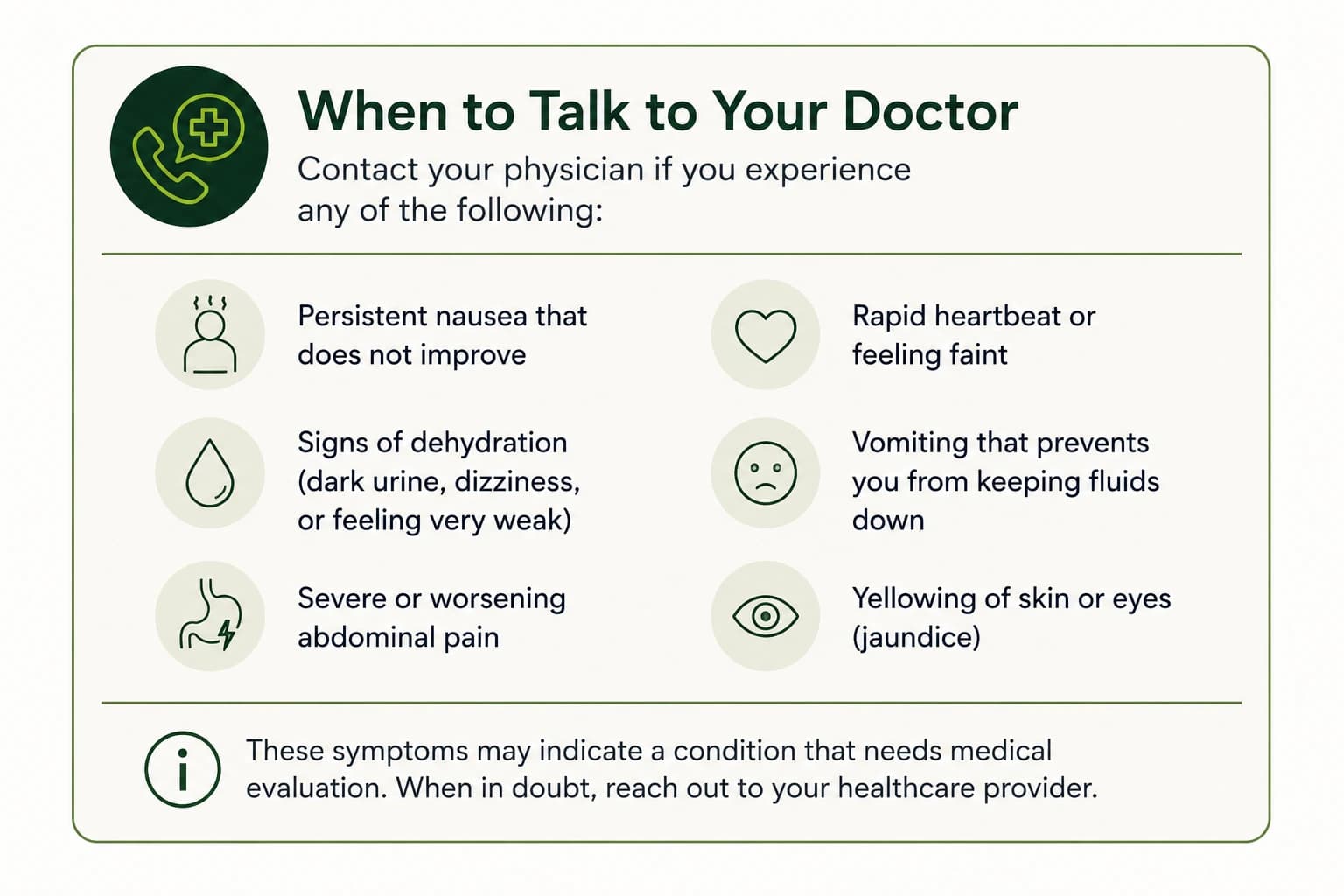
Most of what people experience on a GLP-1 falls into the “common and expected” category: mild nausea, especially after dose increases; some constipation or loose stools; a noticeably smaller appetite. Those are the predictable echo of the mechanism described above. A smaller set of symptoms are worth a call to your doctor rather than something to wait out: vomiting that won't stop, signs of dehydration (dizziness, very dark urine, not urinating), severe or worsening abdominal pain, or any symptom that feels genuinely different from the usual digestive adjustment.
This page can't tell you which category you're in — only your doctor, who knows your history, can do that. If you want to understand your own appetite and digestion signals more broadly, whether or not you're on a GLP-1, the free BeyondGLP Metabolic Assessment is a good place to start.
Common Questions
Why does GLP-1 cause nausea?
Because the hormone's main job is to slow how fast your stomach empties. A medication that keeps that signal active for days, rather than minutes, keeps food in the stomach longer than usual — and that's what produces the sensation of nausea and early fullness, especially early in treatment or after a dose change.
Are GLP-1 side effects a sign the medication is working?
Not directly, but they're related. The digestive effects and the appetite-reducing effects come from the same extended hormone signal, so it isn't surprising the two often show up together. That said, some people lose weight with very few digestive symptoms, and that doesn't mean the medication isn't working.
How long do GLP-1 side effects last?
For most people, digestive symptoms are most noticeable in the first few weeks after starting or after a dose increase, and ease as the body adjusts. How your dose is managed over time, and how long any particular symptom should reasonably last for you, is a conversation with your prescribing physician rather than something this page can answer generally.
Does GLP-1 cause muscle loss?
Weight lost on a GLP-1 isn't only fat. A 2025 meta-analysis found lean tissue accounted for roughly a quarter of total weight lost across 22 randomized trials. We cover what that means, and what the evidence says about protecting lean mass, in a dedicated article.
Do side effects mean I should stop?
Not necessarily, and it isn't a decision to make on your own. Side effects are one of the most common reasons people consider stopping a GLP-1, but stopping changes more than how you feel day to day — it's worth talking through with your doctor. We explain the physiology of stopping in a separate article.
Related metabolic signals
Scientific References
- Drucker DJ. Mechanisms of Action and Therapeutic Application of Glucagon-like Peptide-1. Cell Metab. 2018;27(4):740–756.
- van Bloemendaal L, IJzerman RG, Ten Kulve JS, et al. GLP-1 receptor activation modulates appetite- and reward-related brain areas in humans. Diabetes. 2014;63(12):4186–4196.
- Wilding JPH, Batterham RL, Calanna S, et al. Once-Weekly Semaglutide in Adults with Overweight or Obesity (STEP 1). N Engl J Med. 2021;384(11):989–1002.
- Karakasis P, Patoulias D, Fragakis N, Mantzoros CS. Effect of glucagon-like peptide-1 receptor agonists and co-agonists on body composition: systematic review and network meta-analysis. Metabolism. 2025;164:156113.
Understand your own appetite and digestion signals, with or without a GLP-1 medication.
Take the free BeyondGLP Metabolic Assessment →BeyondGLP focuses on your body's own (endogenous) GLP-1 — the hormone your gut releases to regulate appetite — which is distinct from prescription GLP-1 medications. This content is educational and explains physiology; it is not medical advice and does not provide dosing or treatment guidance. Always consult a qualified healthcare provider about medications and medical decisions.
Educational content only. Information explains physiology and is not intended as medical advice. Always consult a qualified healthcare provider regarding medical decisions.