Metabolic Health Starts Inside Your Cells (What Mitochondria Actually Do)
The cell, not a mysterious rate, is where metabolic health starts.
Written by BeyondGLP Editorial Team · Medically reviewed by Dr. Gabriel, MD
Key Takeaways
- Metabolism is not an abstract "rate" — it happens physically inside every cell, mostly in the mitochondria.
- Mitochondria convert the nutrients you eat into usable cellular energy through cellular respiration.
- When cells are overloaded with fuel and fat is stored where it shouldn't be, insulin signaling inside cells is disrupted — that is where metabolic dysfunction begins.
- Only about 1 in 8 US adults are metabolically healthy — and the roots of that trace down to the cellular level.
- Everyday inputs like a Western/ultra-processed dietary pattern shape the microbiome and cellular metabolic environment.
From Dr. Gabriel
My background is in molecular genetics, and it changed how I think about metabolism permanently. “Slow metabolism” isn't a single dial somewhere in your body — it's the sum of billions of tiny reactions happening inside every one of your cells, right now, guided by the same DNA blueprint in each one. When I explain this to patients, the reaction is usually less “that's discouraging” and more “oh, that actually makes sense.” Understanding where metabolism actually happens is the first step toward taking it seriously, without falling for shortcuts that promise to fix something that was never broken in a single place.
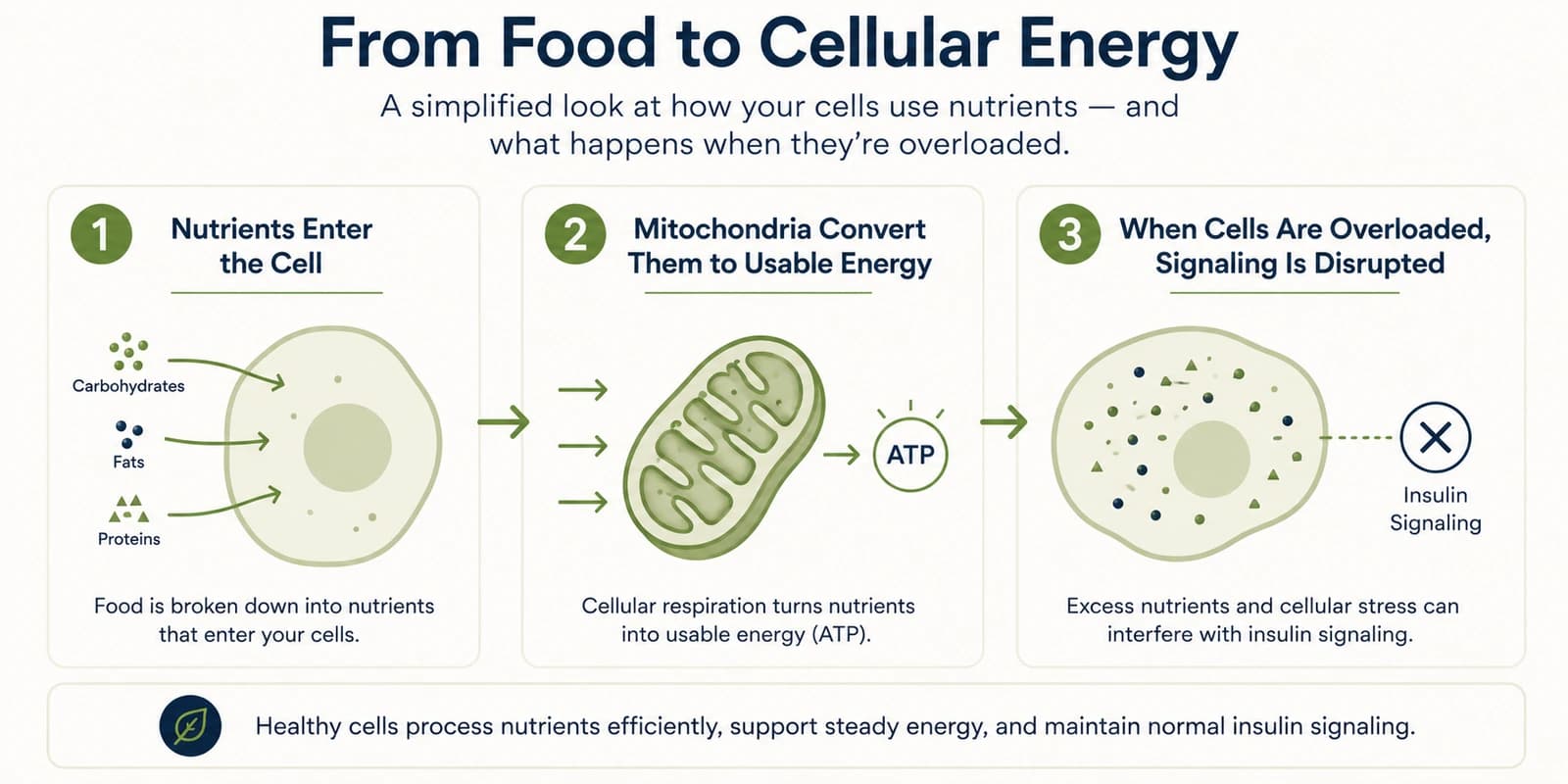
Metabolism gets talked about like a single number: you either have a “fast” one or a “slow” one, something decided at birth and mostly out of your hands. That framing skips the actual biology. Metabolism isn't one thing happening somewhere in your body — it's billions of chemical reactions happening inside your cells, right now, mostly inside structures called mitochondria. Only about 1 in 8 US adults currently meet the criteria for optimal metabolic health, and the roots of that number trace all the way down to what's happening inside individual cells. This article explains, in plain terms, what mitochondria actually do, how cellular metabolism connects to insulin resistance, and why the cell — not some abstract “rate” — is where metabolic health actually starts.
What This Means in Plain English
Cellular metabolism is the sum of chemical reactions your cells use to turn the food you eat into usable energy and the building blocks needed to keep functioning. Mitochondria are the primary sites where that conversion happens — they take in nutrients and oxygen and, through a process called cellular respiration, produce usable energy in a form your cells can actually spend.
This isn't a special process reserved for exercise or metabolism-focused biohacking. It's happening in essentially every cell in your body, every second, whether you're asleep, at your desk, or reading this sentence. Every one of those cells is following the same DNA blueprint, which is part of why understanding metabolism at the cellular level, rather than treating it as a mysterious number, actually clarifies more than it complicates. This is normal physiology, not a system waiting to be optimized.
Why This Happens Biologically
Cells are built to handle a certain amount of fuel at a time. When they're chronically overloaded — more nutrients arriving than the cell can use or store appropriately — fat begins accumulating in places it isn't designed to be stored in large amounts, particularly the liver and skeletal muscle. This is called ectopic fat, and it directly interferes with insulin signaling inside the cell, one of the core mechanisms behind insulin resistance.1
Mitochondrial function and low-grade inflammation are both part of this picture, influencing how well a cell can respond to insulin's signal in the first place. None of this is about a “slow metabolism” failing you. It's a regulatory system under real, measurable strain — cells doing their best to manage more fuel than they're equipped to handle gracefully. Understanding it this way changes the target: not a mysterious rate to blame, but a specific, well-studied mechanism to understand.
How It Connects to the Whole Metabolic System
Zoom out from a single cell, and the picture scales up. Visceral fat (around your organs) and ectopic fat (in tissues like the liver) are established drivers of cardiometabolic risk at the level of the whole body, not just the cell.2 The same disruption described inside individual cells — fuel overload interfering with insulin signaling — is part of what connects cellular biology to the broader story of metabolic disease: elevated blood sugar, unfavorable cholesterol patterns, higher blood pressure, and increased cardiovascular risk.
This is the throughline between what's happening inside one cell and what shows up on a lab panel or a doctor's assessment. If you want to see how this connects to insulin resistance specifically, or to the broader metabolic system BeyondGLP maps across five domains, those are the next two places to go.
What Standard Advice Often Misses
Most metabolism advice stops at “eat less, move more” without addressing the environment your cells actually operate in day to day. A Western, ultra-processed dietary pattern interacts with your gut microbiome in ways that shape that environment — a 2018 review describes how ultra-processed foods, a hallmark of Western dietary patterns, may promote structural and behavioral changes in the resident gut microbiome that are associated with inflammation and metabolic disease risk.3
This is an association described in the cited research, not a treatment claim, and it doesn't come with a specific protocol or a list of foods that “boost mitochondria” — that kind of language oversimplifies a genuinely complex relationship. What it does offer is a layer of context usually missing from generic advice: your cells aren't operating in a vacuum. The broader dietary pattern and the microbial environment it shapes are part of the picture, alongside, not instead of, everything else that goes into metabolic health.
How to Know Where You Stand
You can't feel a single mitochondrion doing its job, and no home test measures cellular respiration directly. But whole-body markers — blood sugar, waist circumference, blood pressure, lipid patterns — give a meaningful picture of how well that cellular-level system is functioning overall, and your doctor can help you interpret what they mean for you specifically.
This article opens what we're calling the Cellular Health cluster — more pieces on this topic are coming. In the meantime, if you want a broader picture of your own metabolic signals, from appetite to sleep to stress response, the free BeyondGLP Metabolic Assessment is the place to start, and our guide on insulin resistance picks up directly where this one leaves off.
Common Questions
What do mitochondria actually do?
They're the primary site inside your cells where nutrients and oxygen are converted into usable energy, through a process called cellular respiration. Every cell in your body relies on this, continuously.
How does cellular metabolism connect to insulin resistance?
When cells are chronically overloaded with fuel, fat can accumulate in tissues like the liver and muscle that aren't designed to store much of it. That ectopic fat interferes with insulin signaling inside the cell — one of the core mechanisms of insulin resistance.
Is "slow metabolism" a real thing?
Metabolism isn't a single dial; it's billions of cellular reactions happening simultaneously. Some genuine variation exists between people, but framing a "slow" or "fast" metabolism as a fixed, single-number trait oversimplifies a much more distributed, cellular process.
Does diet affect metabolism at the cellular level?
Yes — the broader dietary pattern you eat interacts with your gut microbiome in ways associated with the metabolic environment your cells operate in, according to a 2018 review of the Western diet-microbiome relationship.
How many adults are actually metabolically healthy?
A 2019 analysis of national US health data found that only about 12%, roughly 1 in 8 adults, met the criteria for optimal metabolic health across markers like blood sugar, blood pressure, and waist circumference.
Related metabolic signals
Scientific References
- Petersen MC, Shulman GI. Mechanisms of Insulin Action and Insulin Resistance. Physiol Rev, 2018;98(4):2133–2223.
- Neeland IJ, Ross R, Després JP, et al. Visceral and ectopic fat, atherosclerosis, and cardiometabolic disease: a position statement. Lancet Diabetes Endocrinol, 2019;7(9):715–725.
- Zinöcker MK, Lindseth IA. The Western Diet-Microbiome-Host Interaction and Its Role in Metabolic Disease. Nutrients, 2018;10(3):365.
- Araújo J, Cai J, Stevens J. Prevalence of Optimal Metabolic Health in American Adults: NHANES 2009–2016. Metab Syndr Relat Disord, 2019;17(1):46–52.
Take the free BeyondGLP Metabolic Assessment
See a whole-body picture of how well your cellular-level system is functioning.
Take the free BeyondGLP Metabolic Assessment2-minute quick check → /quick-check
Educational content only. Information explains physiology and is not intended as medical advice. Always consult a qualified healthcare provider regarding medical decisions.