Why Menopause Changes Your Metabolism (And What Actually Helps)
It's a hormonal shift you can work with — not a discipline failure.
Written by BeyondGLP Editorial Team · Medically reviewed by Dr. Gabriel, MD
Key Takeaways
- The metabolic shift at menopause is a real hormonal change — not a discipline failure.
- As estrogen falls, fat tends to shift toward the midsection and energy expenditure can drop.
- Insulin sensitivity can slip during this transition, which is why blood sugar is worth minding more closely.
- Protein, strength training, sleep, and fiber are the highest-leverage habits — they work with the biology, not against it.

From Dr. Gabriel
So many patients show up apologizing for their weight, as if menopause were a personal failing they should have prevented. It isn't. What's actually happening is that a hormone your body relied on for decades to help manage fat storage and blood sugar has stepped back, and the body is genuinely re-negotiating how it runs. That reframe changes the conversation from self-blame to strategy. You're not fighting your own willpower — you're working with a body that's operating under new hormonal terms, and there are specific, well-supported ways to work with that.

You're eating the way you always have, maybe even moving more, and the scale keeps climbing — or the weight is settling somewhere new, around the middle, in a way it never did before. This is real, it's common, and it isn't a sign that you've suddenly lost the discipline that used to work. Metabolic health is already a tightrope for most adults — only about 1 in 8 meet the criteria for it 4— and menopause adds a genuine hormonal shift on top of that baseline. As estrogen declines, your body changes how it stores fat, how much energy it burns at rest, and how well it handles blood sugar. None of that is happening because your habits changed. It's happening because your hormones did.
What This Means in Plain English
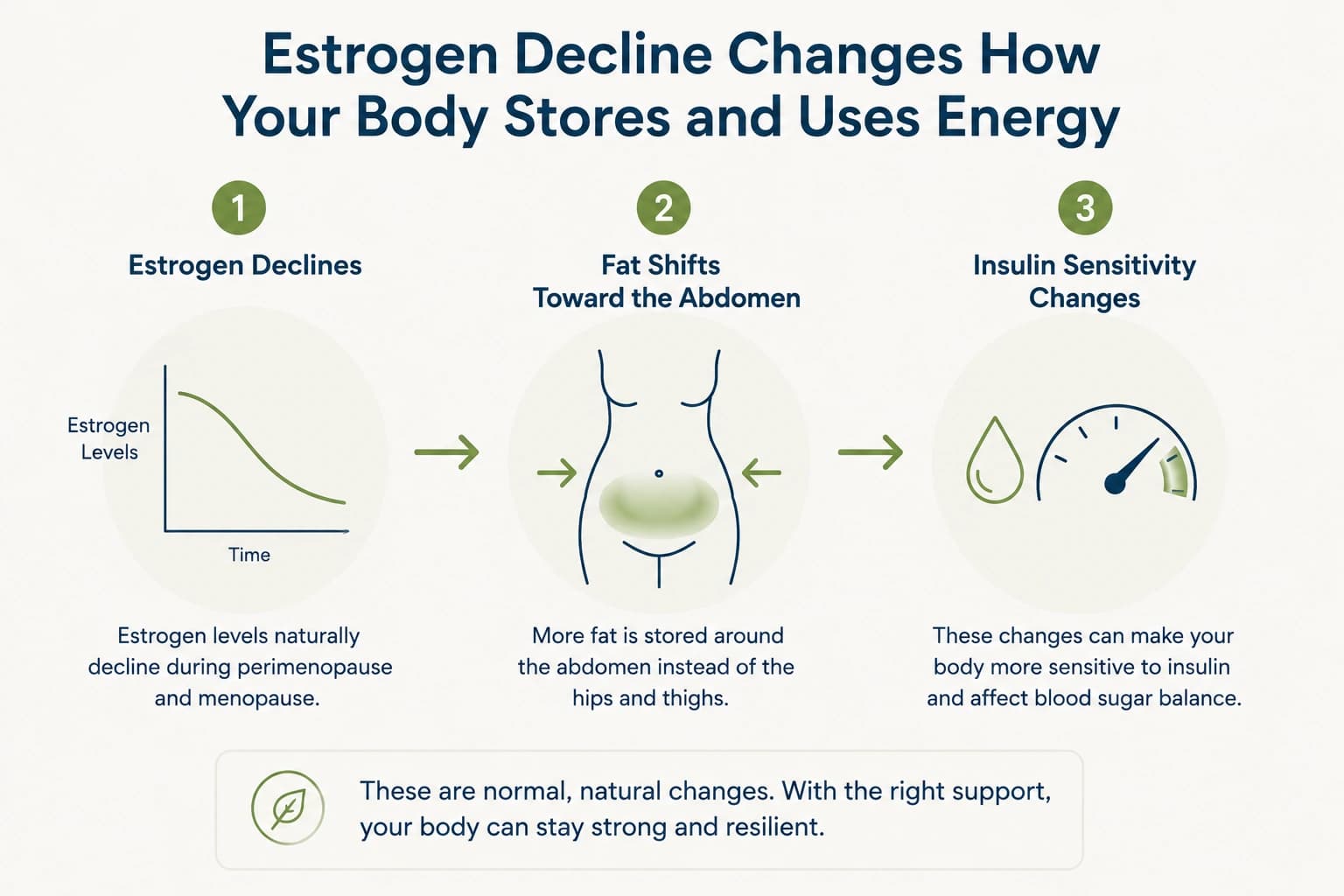
The menopause transition typically unfolds over several years, starting with perimenopause and irregular cycles and ending with the final menstrual period. Throughout this window, ovarian estrogen production declines, and that decline touches far more than reproduction — estrogen receptors sit throughout the body, including in fat tissue, muscle, the liver, and the brain regions that regulate appetite and energy use. You're not imagining the change. It's measurable, and it's been studied directly.
This isn't a vague “slowing metabolism.” It's a specific, describable hormonal transition — and that specificity is what makes it workable.
Why This Happens Biologically
Estrogen plays a direct role in where the body stores fat, how much energy it burns, and how sensitive cells are to insulin. 2 A four-year longitudinal study that followed women through the menopause transition found that fat mass increased and shifted from a subcutaneous, hip-and-thigh pattern toward visceral, abdominal fat, and that this coincided with a measurable drop in energy expenditure — tracked by accelerometry, physical activity fell by roughly half over the study period. 1As estrogen's supportive effect on insulin sensitivity fades, blood sugar handling can shift too, which is part of why some women notice new cravings or energy dips they didn't have before.
How It Connects to the Metabolic Signaling System
The visceral fat gain and lower energy expenditure documented in longitudinal research on the menopause transition track specifically with the hormonal shift itself, not simply with getting older. 1That distinction matters: it means the changes many women notice in their 40s and 50s aren't purely a function of age catching up with them — they're tied to a specific, time-limited biological transition, which also means the transition eventually stabilizes on the other side.
This is a transition your body is moving through, not a permanent new baseline you're stuck at.
What Standard Advice Often Misses
The advice women in this stage usually get — “eat less, move more” — misses what actually protects metabolic health during this window: preserving lean muscle mass. A study following women in their late 60s found that higher protein intake was associated with better preservation of lean mass over time, particularly among those who weren't losing weight. 3Combined with resistance training, which is generally recommended for maintaining strength and metabolic rate through midlife (though it isn't tied to a single trial here), consistent protein intake is one of the highest-leverage habits available. Sleep and fiber intake round out the list — both influence appetite hormones and blood sugar stability, and both tend to be the first things that slip when hot flashes or night sweats disrupt rest.
How to Know Where You Stand
Every woman moves through this transition differently, and the specifics of your own hormones, blood sugar, and energy signals matter more than a general timeline. The free BeyondGLP Metabolic Assessment looks at the Hormones & Stress Response domain alongside the rest of your metabolic picture, to give you a starting point that's actually yours.
If you're considering hormone therapy, that decision belongs in a conversation with your doctor — it depends on your personal and family history in ways a general article can't account for.
Common Questions
Why do I gain weight during menopause even though nothing changed?
Falling estrogen shifts where your body stores fat (more toward the abdomen) and can lower resting energy expenditure and insulin sensitivity — all changes documented in longitudinal research tracking women through the transition. Your habits didn't fail; your hormonal environment changed.
Is menopause belly fat different from other weight gain?
The pattern is different in an important way: research following women through the transition found the fat gain specifically shifted toward visceral, abdominal fat rather than the hip-and-thigh pattern more common before menopause, and this shift tracked with the hormonal transition itself rather than simply with age.
Can I actually do anything about it, or do I just wait it out?
There's real, actionable ground here. Protein intake to preserve lean mass, resistance training, sleep, and fiber are the habits with the most support behind them for this specific transition — they don't reverse the hormonal shift, but they work with it rather than against it.
What about hormone therapy?
Hormone therapy is a real option for some women, but the right choice depends on your personal and family medical history, symptoms, and risk factors. That's a conversation to have directly with your physician — this article can't and shouldn't substitute for it.
Related metabolic signals
Scientific References
- Lovejoy JC, Champagne CM, de Jonge L, Xie H, Smith SR. Increased visceral fat and decreased energy expenditure during the menopausal transition. Int J Obes (Lond). 2008;32(6):949–958.
- Mauvais-Jarvis F, Clegg DJ, Hevener AL. The Role of Estrogens in Control of Energy Balance and Glucose Homeostasis. Endocr Rev. 2013;34(3):309–338.
- Isanejad M, et al. Association of protein intake with the change of lean mass among elderly women (OSTPRE-FPS). J Nutr Sci. 2015;4:e42.
- Araújo J, Cai J, Stevens J. Prevalence of Optimal Metabolic Health in American Adults: NHANES 2009–2016. Metab Syndr Relat Disord. 2019;17(1):46–52.
Physician-built · Free · 2 min
See what's actually driving your metabolism.
Educational content only. Information explains physiology and is not intended as medical advice. Always consult a qualified healthcare provider regarding medical decisions.