Ultra-Processed Foods: What They Are and How They Hijack Your Metabolism
It isn't willpower — the food was engineered to outrun your satiety signals.
Written by BeyondGLP Editorial Team · Medically reviewed by Dr. Gabriel, MD
Key Takeaways
- Ultra-processed foods (NOVA Group 4) are industrial formulations built from extracted substances and additives — not just “packaged.”
- In a controlled inpatient trial, the same people ate roughly 500 more calories a day, unprompted, on an ultra-processed diet than on a matched unprocessed one — and gained weight.
- This is engineering working against your satiety signals, not a failure of willpower.
- A handful of high-leverage swaps — protein-forward, whole-food defaults — beat trying for perfection.

From Dr. Gabriel
Patients describe the same moment to me frequently: they open one bag of chips intending to have “a few,” and the bag is empty before they've registered feeling full. They almost always frame it as a personal weakness. It isn't. A landmark metabolic-ward study put this to a direct test — same people, matched calories and macronutrients on paper, and the ultra-processed version of the diet still led to unprompted overeating and weight gain. That's not a willpower gap. That's food engineered to outrun the signal that normally tells you to stop.
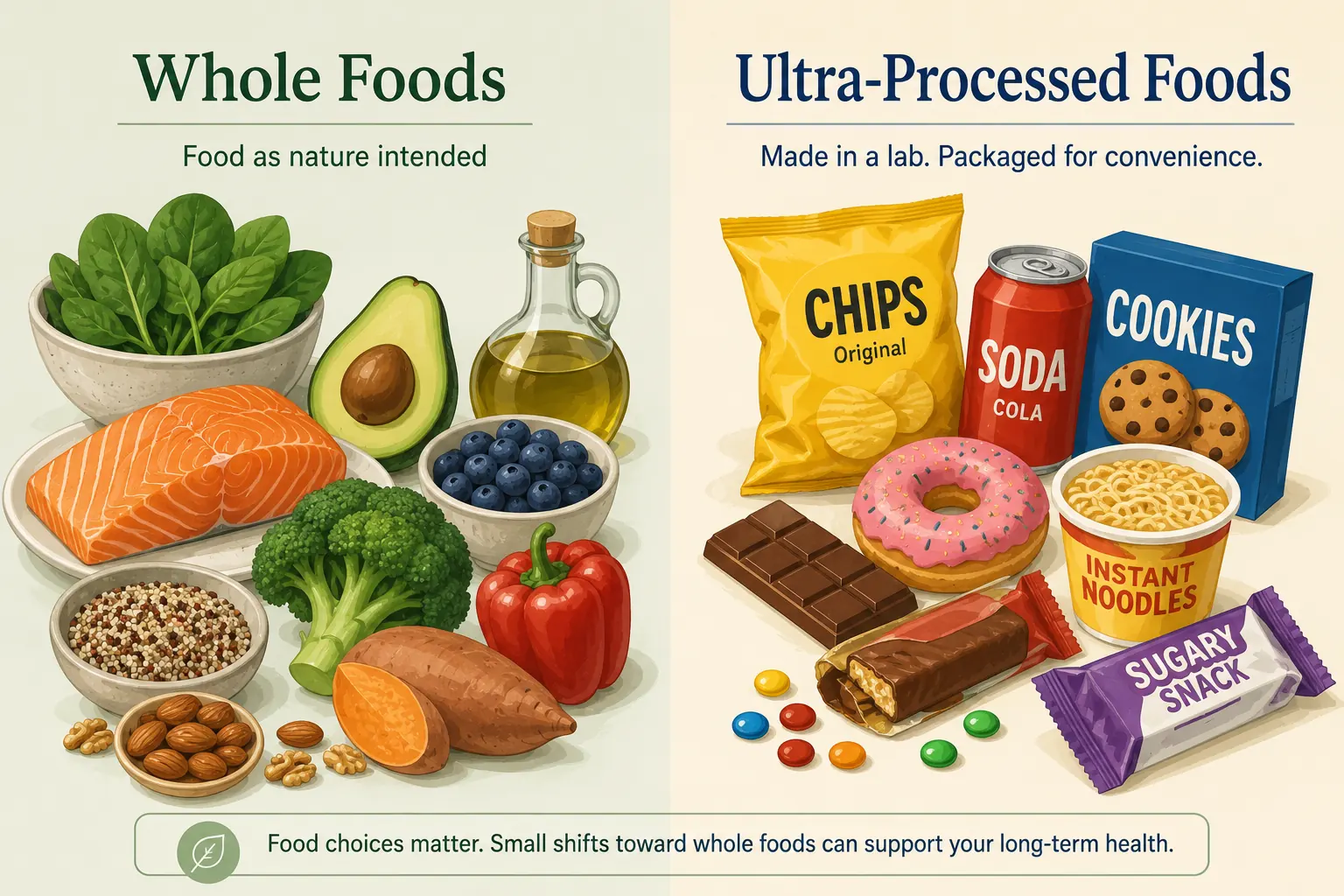
One chip, and then the bag is empty before you've really registered eating any of it. If that's familiar, it's not a character flaw — it's common, and there's a mechanical reason for it. Metabolic health is hard to hold onto even under ordinary circumstances — only about 1 in 8 U.S. adults meet the criteria for it5 — and the modern food supply is a significant part of why. Ultra-processed foods, formally defined as NOVA Group 4, are products made mostly or entirely from substances extracted or derived from foods, combined with additives designed to maximize shelf life, cost efficiency, and palatability.1 They're engineered to be easy to overeat — and understanding the mechanism is the first step to working around it.
What This Means in Plain English
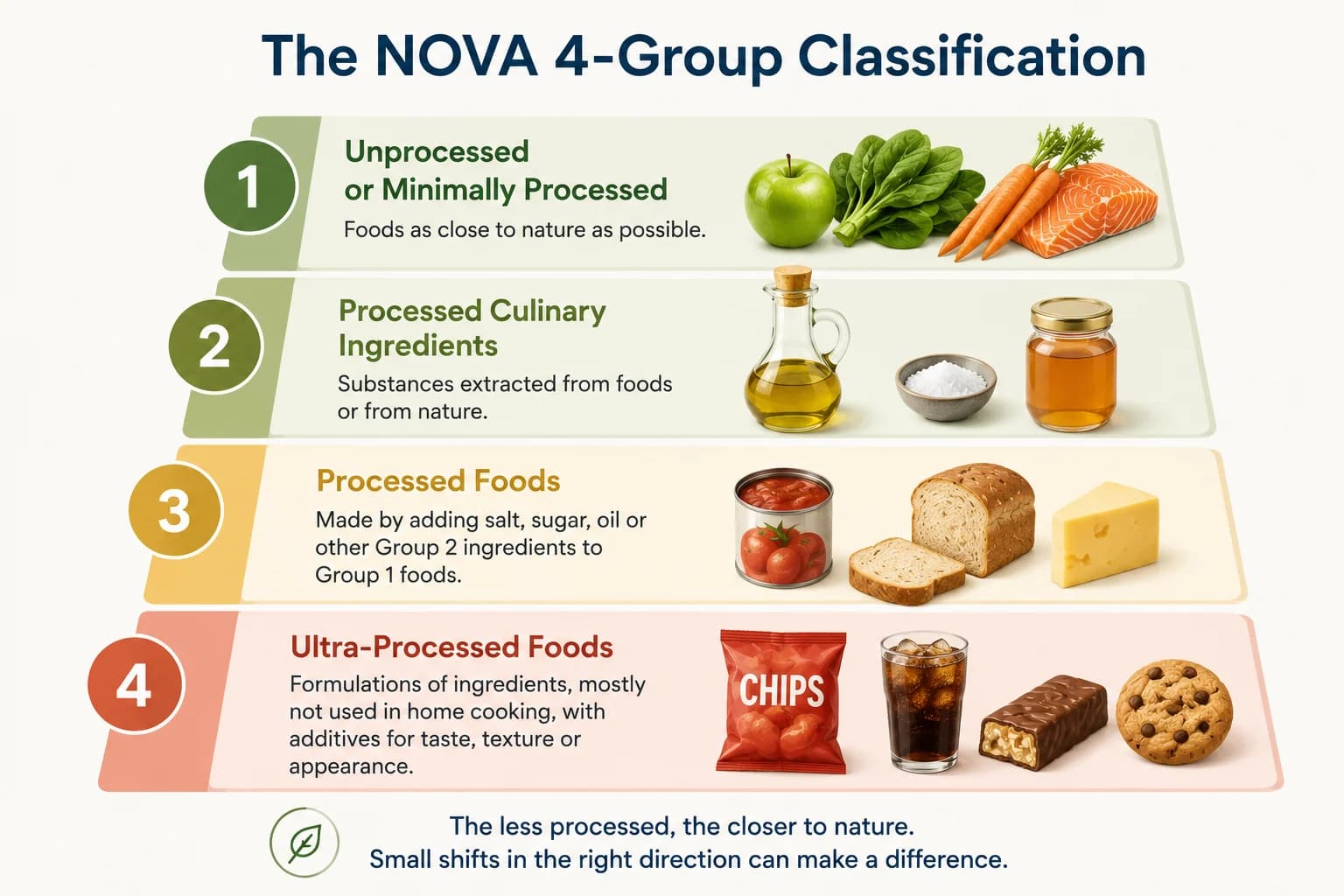
The NOVA classification system sorts all foods into four groups by the extent and purpose of industrial processing, from unprocessed or minimally processed foods (Group 1) through culinary ingredients and processed foods (Groups 2 and 3) to ultra-processed foods (Group 4).1Not all processing is a problem — pasteurized milk and frozen vegetables are processed, and they're fine. The everyday tell for ultra-processed products is the ingredient list: items you wouldn't have in your kitchen, like high-fructose corn syrup, hydrogenated oils, protein isolates, or a long roster of emulsifiers, flavor enhancers, and stabilizers.
The question isn't “is this processed?” — it's “would I recognize everything on this ingredient list?”
Why This Happens Biologically
Several mechanisms work together to make ultra-processed foods easy to overeat. They're often energy-dense and soft in texture, which lets you eat faster than your body's fullness signals can catch up — researchers have characterized specific combinations of fat, sugar, sodium, and carbohydrates as “hyper-palatable,” meaning they hit multiple reward pathways simultaneously in ways whole foods rarely do.3 Many are also formulated to produce a rapid glucose rise followed by a sharper dip, and that post-meal glucose dip has been shown, across a large cohort using continuous glucose monitors, to predict increased hunger and higher food intake in the hours that follow.6 Put together: a fast eating pace, a strong reward hit, and a blood-sugar pattern that primes you to want more, sooner.
How It Connects to the Metabolic Signaling System
The clearest evidence here comes from a randomized inpatient trial at the NIH Clinical Center. Twenty adults were confined to a metabolic ward and given, in random order, two weeks of an ultra-processed diet and two weeks of an unprocessed diet, with both diets matched for presented calories, sugar, fat, sodium, and fiber, and both offered ad libitum — participants could eat as much or as little as they wanted. On the ultra-processed diet, people spontaneously ate about 500 more calories a day and gained weight; on the unprocessed diet, they lost weight.2 A separate meta-analysis pooling multiple observational studies found ultra-processed food intake was associated with significantly higher odds of both overweight and obesity across populations.7 Between a controlled trial establishing the mechanism and population data confirming the pattern, this is one of the more directly supported findings in nutrition science.
This is a randomized, controlled, inpatient trial — not an observational association. The overeating happened even though the two diets looked identical on a nutrition label.
What Standard Advice Often Misses
Standard advice to “eat less” skips the part that actually helps: protein anchors satiety in a way that makes eating less feel less like restriction. Research reviewing higher-protein diets found consistent benefits for appetite control and weight management at intakes around 1.2–1.6 grams of protein per kilogram of body weight, with roughly 25–30 grams of protein per meal identified as a threshold that supports fullness.4Practically, that looks like changing your defaults — what's easiest to grab when you're hungry and not thinking — rather than relying on willpower in the moment. Spacing out snacks that spike and then crash blood sugar helps too, for the reasons covered above.
One more point worth naming honestly: some researchers have proposed, using criteria adapted from substance-use research, that certain highly processed foods may meet criteria for an addictive-like eating pattern in some people.8This is an emerging and still-debated area of research, not an established diagnosis — it's offered here as context, not as a label to apply to yourself.
How to Know Where You Stand
If ultra-processed foods are shaping your appetite and hunger signals more than you'd like, the free BeyondGLP Metabolic Assessment can help map exactly where that's showing up — appetite, blood sugar, energy — so any changes you make target the right thing.
If you're specifically curious how ultra-processed foods interact with GLP-1 and appetite signaling, that connection is covered in more depth on the linked child page.
Common Questions
What are ultra-processed foods, exactly?
They're products classified as NOVA Group 4 — made mostly or entirely from substances extracted or synthesized from foods (like high-fructose corn syrup or hydrogenated oils) plus additives for shelf life, cost, and palatability. The simplest everyday tell is an ingredient list with items you wouldn't have in your own kitchen.
Do ultra-processed foods actually cause weight gain?
A randomized inpatient trial found that people spontaneously ate about 500 more calories a day and gained weight on an ultra-processed diet matched for calories and macronutrients, compared to an unprocessed diet, and a separate meta-analysis of population studies found ultra-processed intake associated with higher odds of overweight and obesity.
Are all processed foods bad for you?
No. The NOVA system distinguishes minimally processed foods (like frozen vegetables or pasteurized milk) from ultra-processed ones. Processing itself isn't the issue — it's the specific combination of extracted substances and additives that defines Group 4.
How do I cut back without giving up everything I like?
Start with protein at each meal — research supports roughly 25–30 grams per meal as a threshold that meaningfully supports fullness — and change your defaults for what's easiest to grab when you're hungry, rather than relying on willpower in the moment.
Related metabolic signals
Scientific References
- Monteiro CA, et al. Ultra-processed foods: what they are and how to identify them. Public Health Nutr. 2019;22(5):936–941.
- Hall KD, et al. Ultra-Processed Diets Cause Excess Calorie Intake and Weight Gain: An Inpatient Randomized Controlled Trial. Cell Metab. 2019;30(1):67–77.
- Fazzino TL, Rohde K, Sullivan DK. Hyper-Palatable Foods: Development of a Quantitative Definition and Application to the US Food System Database. Obesity. 2019;27(11):1761–1768.
- Leidy HJ, et al. The role of protein in weight loss and maintenance. Am J Clin Nutr. 2015;101(6):1320S–1329S.
- Araújo J, Cai J, Stevens J. Prevalence of Optimal Metabolic Health in American Adults: NHANES 2009–2016. Metab Syndr Relat Disord. 2019;17(1):46–52.
- Wyatt P, et al. Postprandial glycaemic dips predict appetite and energy intake in healthy individuals. Nat Metab. 2021;3(4):523–529.
- Askari M, Heshmati J, Shahinfar H, Tripathi N, Daneshzad E. Ultra-processed food and the risk of overweight and obesity: a systematic review and meta-analysis. Int J Obes. 2020;44(10):2080–2091.
- Gearhardt AN, DiFeliceantonio AG. Highly processed foods can be considered addictive substances based on established scientific criteria. Addiction. 2023;118(4):589–598.
Physician-built · Free · 2 min
See what's actually driving your metabolism.
Educational content only. Information explains physiology and is not intended as medical advice. Always consult a qualified healthcare provider regarding medical decisions.